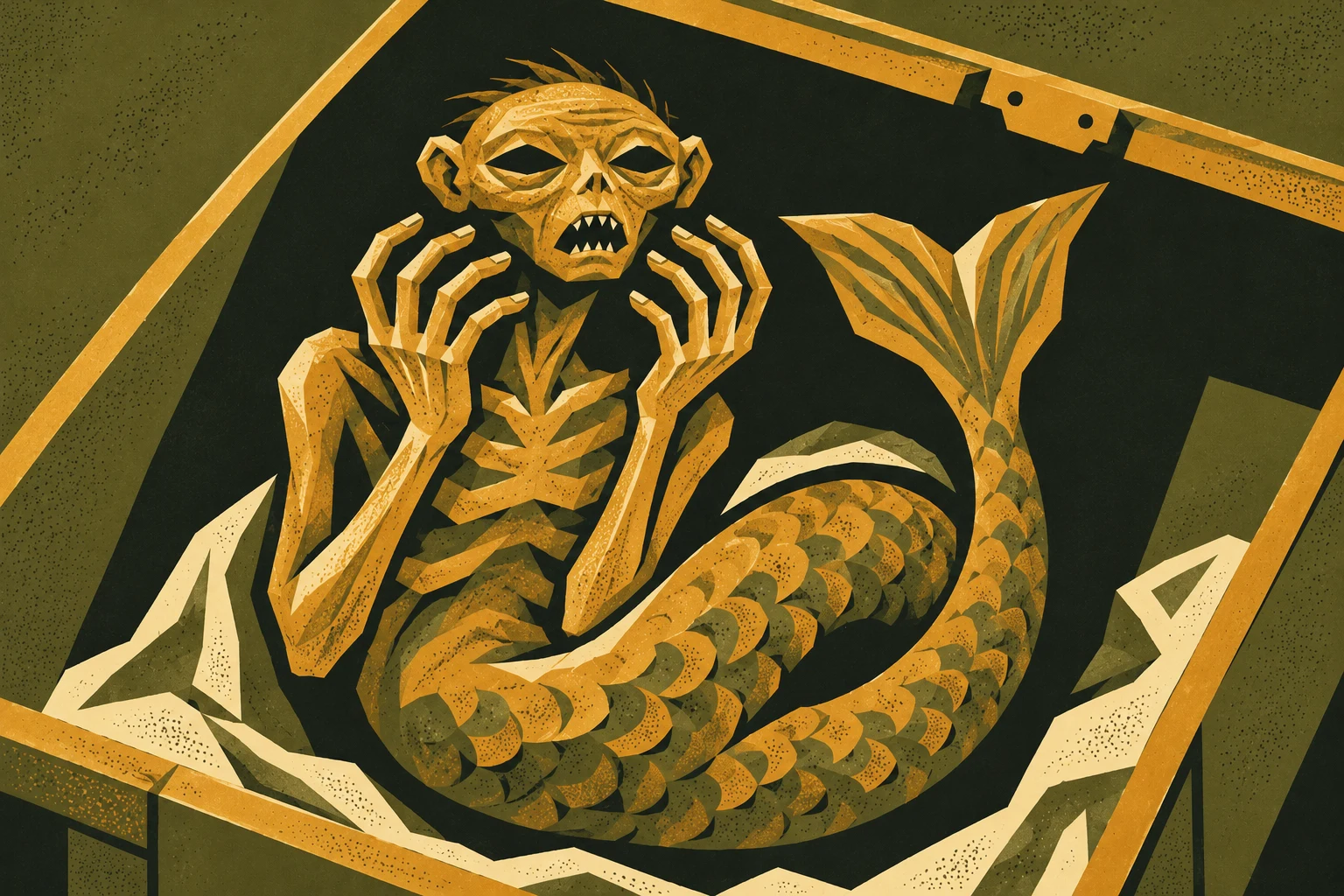
The little body has teeth, fingernails and hands raised beside its face, as though it died protesting. Enjuin temple’s mermaid survived long enough to enter a scanner, where its human appearance began to come apart.1
A photograph leads back to the box
In February 2023, a research team in Okayama announced that a mermaid preserved at a Buddhist temple was a manufactured object. The investigation had taken about a year. Its result supplied a material explanation for a body that had attracted prayers and speculation, while leaving the identity of its maker untouched. At Enjuin, there was no announcement that the object would be discarded: local broadcaster KSB reported that the temple would continue to keep it.2
The mummy measures about thirty centimetres. It has a scaled lower body, a small head and an open mouth. Its preservation at Enjuin, in Asakuchi, had given it a setting very different from a fairground booth. A temple could keep an unsettling object safe while allowing it to acquire associations with protection and good health. By the time the researchers arrived, its latest custodian was willing to let instruments examine something that people had approached through belief.1
The investigation began with a photograph. Hiroshi Kinoshita, a board member of the Okayama Folklore Society, encountered an image of the mummy among materials left by the natural historian Kiyoaki Sato. Sato, who died in 1998, had collected and written about the supernatural creatures known as yōkai. Kinoshita traced the object to Enjuin and approached the temple and university about a joint project.1
It was a rediscovery within a local history, rather than an unknown corpse suddenly coming out of the earth. In August 2020, RSK radio had visited an exhibition about Sato at Satosho’s library. Among its attractions was a rediscovered photograph of a mermaid mummy. The programme then went to Enjuin and spoke to the priest. The radio account described the teeth and nails, the scales on the fish section, and the account of earlier owners kept with the body.3
That visit catches the object before it became an international science story. In the library, the photograph belonged among documents, plants and people connected with a local natural historian. At the temple, the mummy was something to preserve. RSK reported that it was not then generally on public display. The priest wanted to take care of it in the future. Neither setting required a newly discovered species to make the object interesting.3
The box supplied a much older beginning. According to its accompanying note, a creature had entered a fishing net off Tosa, the old province corresponding to present-day Kōchi, during the Genbun era in the eighteenth century. It was carried to Osaka, bought by an ancestor of a family in the Fukuyama area and kept as a treasure. A later transfer was dated to November of Meiji 36.3 The university’s historical investigators could verify neither the named people nor a direct connection between that account and this particular mummy.4
A net, a market and a household heirloom give the tale a reassuring sequence. The mermaid begins in the sea and moves into private possession by an ordinary purchase. What is missing is the independent record that would let the story be followed through those hands. There is also no secure account of how it reached Enjuin. The body and its written history had arrived together at the laboratory, but they presented different problems.1
Inside the borrowed mermaid
The university announced the project on 9 February 2022, a week after work began. The temple had agreed to collaborate with Kurashiki University of Science and the Arts, Kinoshita and the Kurashiki Museum of Natural History. Takafumi Kato, a specialist in fossil mammals, would analyse the upper body; fish specialist Hitomi Yamano would study the lower portion; Hiroshi Takemitsu would undertake molecular work. Folklore and history were part of the investigation from the outset.5
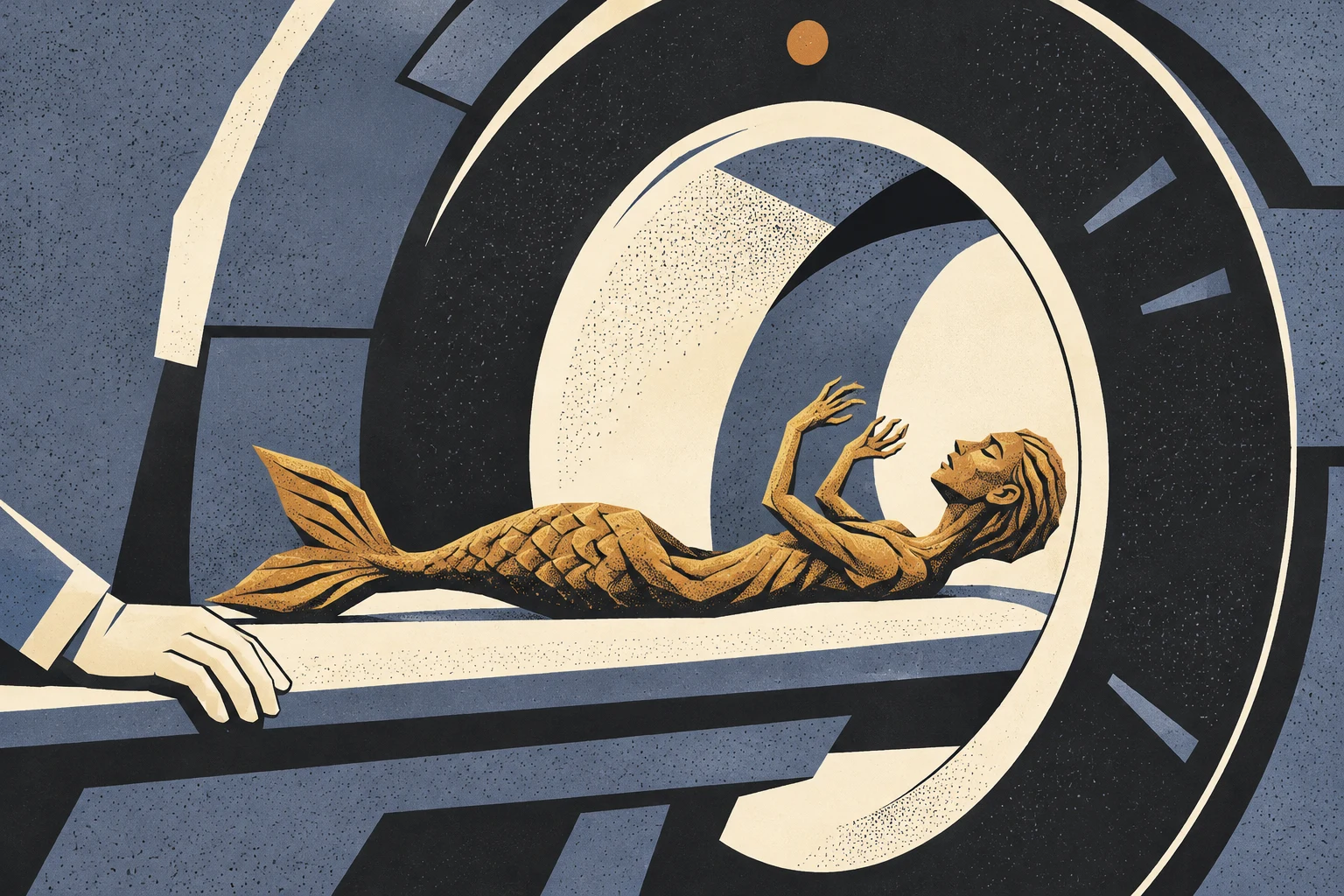
The first loan was brief. X-rays and computed tomography were carried out on 2 and 3 February 2022, alongside surface observation, photography and collection of material that had already detached. Examination continued on 4 February, and the mummy was returned to the temple that afternoon. The university’s account emphasised its safe return. Much of the subsequent work could proceed with images and loose fragments, leaving the fragile body in its custodian’s care.5
The interim findings, dated 29 March and released in April 2022, showed why appearances were misleading. The face looked primate-like, but the teeth were curved cones; there were no corresponding mammalian molars. Parts of the arms and shoulders carried scales different from those on the lower body. Internal organs were not observed. The team could see skeletal material in the jaws, fins and tail, together with needles in the neck and dorsal fin.6
These were useful details because they divided up the apparent creature. A hand, a face and a fish tail invite recognition before anyone has asked how they are connected. The early examination made those joins and surfaces the subject of the enquiry. It also allowed the researchers to choose small detached pieces for further tests without treating the object as something that could be freely taken apart.
Results were originally expected in September. The university postponed the final report to obtain higher-resolution CT images and carry out more detailed analysis. Its notice was updated with the eventual press-conference date, 7 February 2023. The extra months were spent trying to see the construction more clearly.7
The final findings described a modelled upper body: cloth, paper and cotton filling, plaster-like material, layered paper, pufferfish skin and attached animal hair. The lower body had fish skin with features of the croaker family, Sciaenidae. The jaws belonged to a carnivorous fish of unidentified species. There was no skull, spine or rib cage forming a continuous animal skeleton; small metal needles remained within the construction. DNA was not detected. Radiocarbon work on a detached scale suggested the late nineteenth century.4
What the date means: The scale supplied a probable period for material used in the object, not a dated maker’s signature or a precise year of assembly.4
The answer was more skilful, and stranger, than the familiar suggestion of a monkey sewn to a fish. The apparent creature had been composed. Different materials supplied its volume, surface and recognisable features. A substantial part of the illusion lay in persuading the eye to read those features as belonging to one body.2

A creature with several lives
Long before scanners, Japanese writers were asking where such bodies belonged. Historian Andrea Castiglioni has followed the ningyo, literally the human-fish, through Edo and Meiji culture. In his research, the creature moves between entertainment, household protection, religious practice and natural history. Those settings overlap. A fabricated mermaid could attract amused spectators and serious attention without every participant understanding the encounter in the same way.8
One of his examples begins a long way from a Japanese temple. On 1 March 1873, historian and painter Kume Kunitake visited a museum in The Hague during the Iwakura diplomatic mission to Europe and the United States. Among its Japanese holdings were manufactured creatures. Kume recognised the artisan’s intervention. He also noticed that objects which were not necessarily regarded as art at home could become museum attractions abroad.8
Kume’s response, as Castiglioni reads it, contained both scepticism and admiration. Scientific scrutiny would expose the illusion; the work still displayed the skill of Japanese makers and their success in exciting European curiosity. The museum had changed the object’s surroundings and its audience. An impossible animal could sit between art and natural history, valued partly for the ingenuity with which it crossed that boundary.8
Enjuin’s mummy belongs to the same broad world of manufactured human-fish, although its workshop and early movements remain unknown. The overseas examples make an export market plausible as a general context. They cannot identify its original customer. An object kept at a temple might have begun as a commercial curiosity, a household possession or an offering. Its present setting supplies the latest chapter, not an automatic explanation of the first.48
The bodily form also carried meanings that the word mermaid can obscure. Japanese ningyo traditions do not resolve into a single beautiful woman with a tail. Stories place human resemblance within something frightening or difficult to classify. Kimie Itakura’s account for Nippon.com describes the legend of Yao Bikuni, a girl who eats mermaid flesh and remains youthful for centuries, eventually becoming a Buddhist nun. Versions differ, including one associated with Okayama that gives her a thousand-year life.9
In that tradition, the alarming body offers a benefit through being consumed. Elsewhere, images or preserved bodies could be credited with protective powers. Nippon.com records associations with longevity, health, safe childbirth and warding off misfortune. These uses help explain why a mermaid could be worth keeping in a religious setting even when its appearance was grotesque. Beauty was never the necessary attraction.9
At Enjuin, the pandemic gave protection an immediate meaning. The chief priest compared the mummy with Amabie, the legendary plague-averting creature, and told the Asahi Shimbun:
We have worshipped it, hoping that it would help alleviate the coronavirus pandemic even if only slightly.
Amabie supplied a comparison, not an anatomical identification. The temple’s mermaid could enter a living practice of hope without matching every detail of another creature’s story. The priest’s willingness to support research also makes it difficult to cast the investigation as a confrontation between a secretive temple and outsiders determined to force open its box.15
Seven coins and a packed lunch
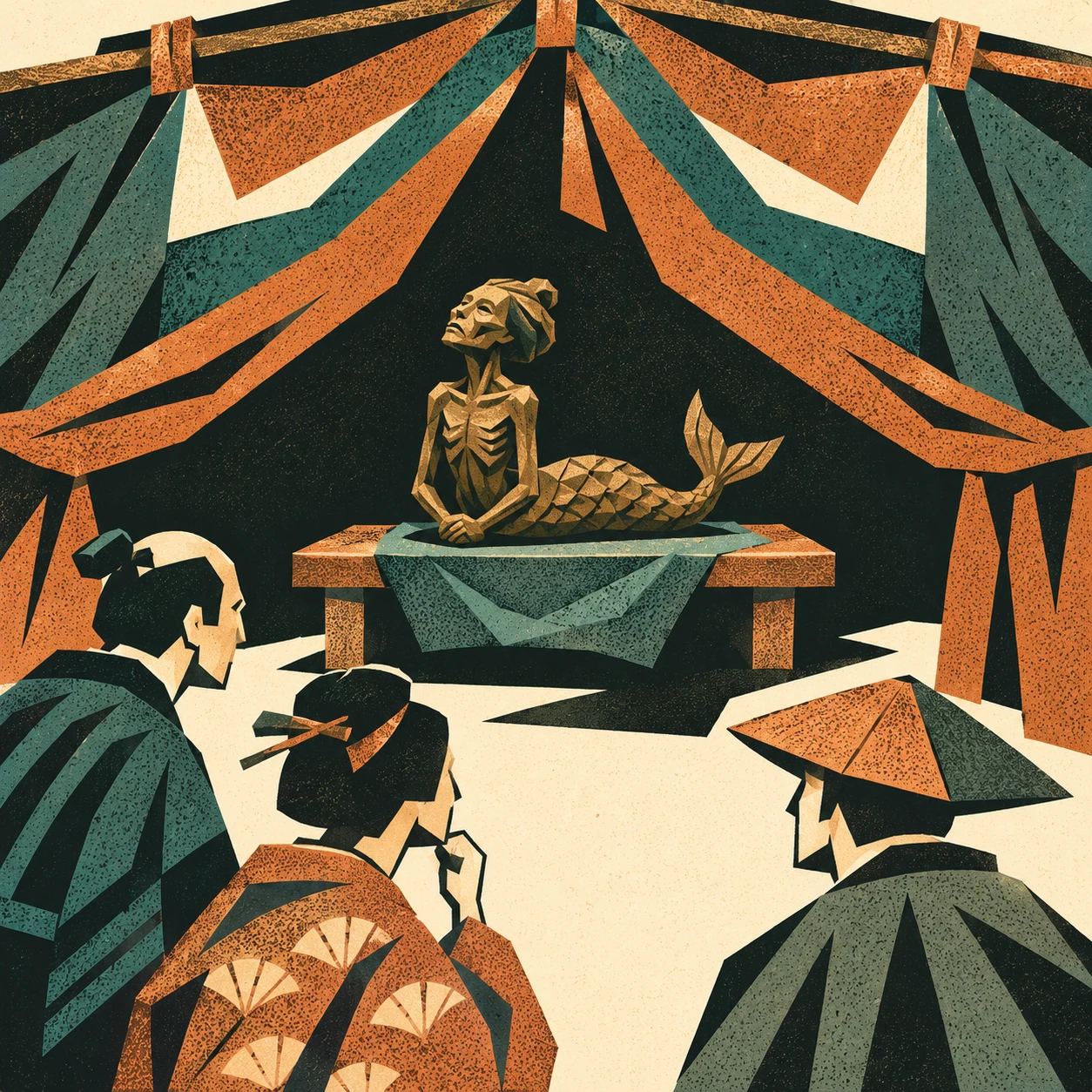
The mermaid also had a paying public. Castiglioni draws on a diary kept by Asaba Nisaburō, a village headman in the Miura district. In the first month of 1857, members of Asaba’s household went to a ningyo exhibition in Edo’s Kodenma-chō district. A man called Ōsakaya Jihei organised the attraction. Admission cost seven mon, and visitors received a packed lunch to eat inside the booth.8
The diary offers a small, useful correction to a picture of sideshows populated only by the gullible or desperate. These visitors belonged to a village headman’s household. When they came out, they discovered that five or six other people from their village had also attended. Seeing the mermaid was an outing, shared across a local network and remembered in the same spare prose as other activities.8
The entry leaves the actual exhibit indistinct. Castiglioni cannot determine whether the spectators saw a preserved body or a performer fitted with a fish-like prosthesis. Both belonged to the range of things that could be presented as ningyo. The uncertainty is revealing: a diary can preserve the price of admission and the lunch more securely than the anatomy of the attraction.8
Illustrated satire explored that ambiguity openly. Castiglioni discusses images in which a human performer and an artificial fish section come apart, exposing a stage device. The joke relied on an audience recognising the composite. Displaying the means of deception could be entertaining in itself, just as a conspicuously impossible body could invite an argument about how it had been made.8
The appeal of a mermaid therefore extended beyond a visitor deciding whether an unfamiliar animal was real. People might attend to see a marvel, inspect a craft, enjoy a performance or participate in a protective encounter. Those possibilities could occupy the same booth. A newspaper advertisement or a later museum label tends to flatten the range into a single promise of authenticity.8
Western retellings often supplied a simpler villain. In his 1869 Eccentricities of the Animal Creation, John Timbs reproduced an account from an 1841 book about Japan. A fisherman supposedly joined a monkey’s upper body to a fish, claimed to have caught it alive and collected money from spectators. Before dying, his creature predicted prosperous years followed by a fatal epidemic.10
The cure in the story was possession of the mermaid’s likeness. The maker could profit from the exhibition and from selling pictures. Timbs’s account then followed a specimen, or perhaps an imitation of the first, through Dutch hands and Batavia to an American who exhibited it in Europe in 1822–1823. Even the narrative allowed uncertainty about whether the same body had made every stage of the journey.10
This was a tale of entrepreneurship wrapped around a warning about credulity. Its structure joined the exotic animal, the epidemic prophecy and a saleable image, with money as the motive connecting them. It helps explain the assumptions later attached to manufactured mermaids. It does not supply a biography for the little body in Enjuin’s box.10
Timbs also recounted the London exhibition at the Egyptian Hall in 1822, giving daily attendance as three to four hundred. He quoted a critic who accepted the ingenuity of the construction while rejecting the animal. Exposure did not immediately empty the attraction. Visitors continued to come. An argument over a mermaid could keep it visible as effectively as an advertisement announcing one.10
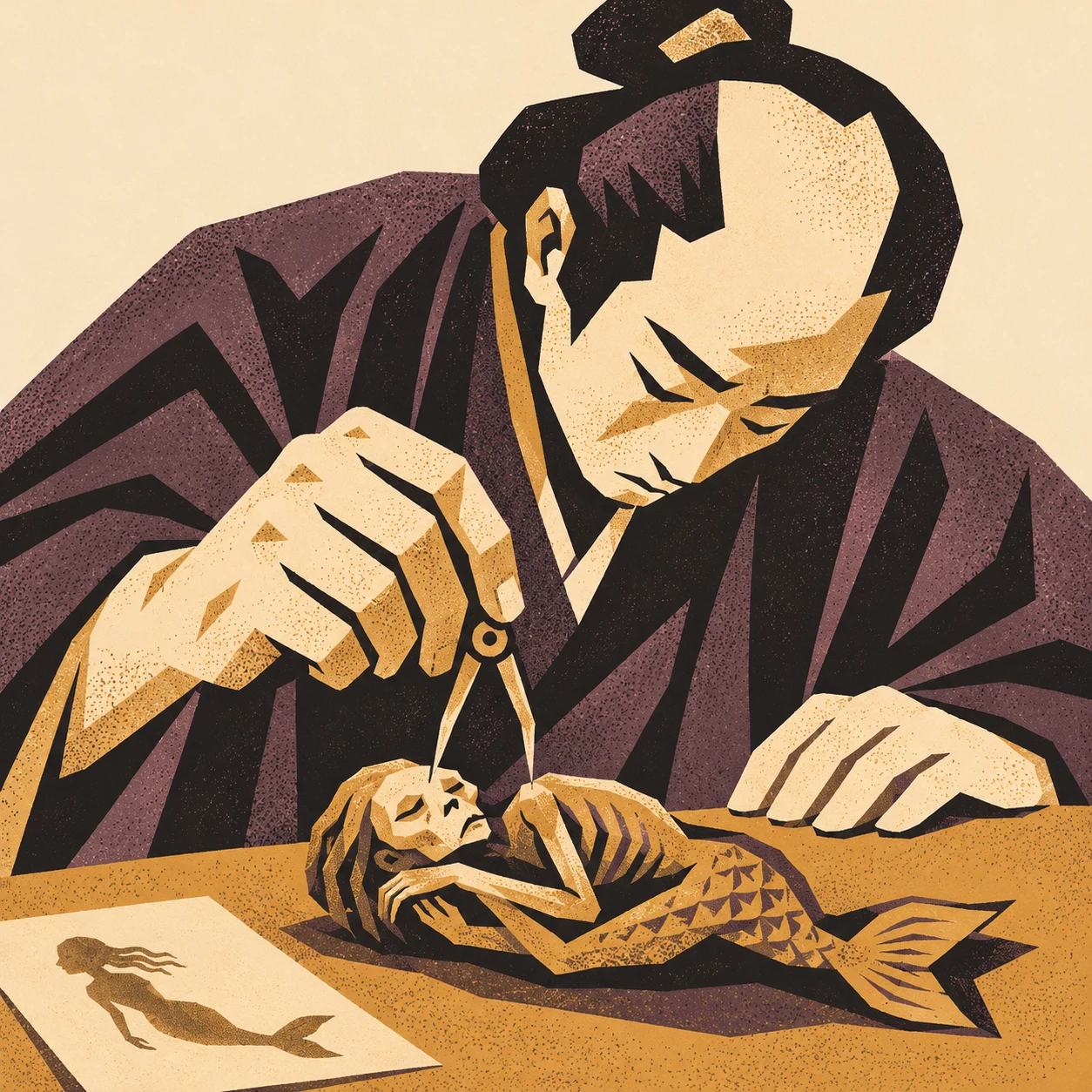
The naturalist and his own monster
The nineteenth-century sceptic could have a blind spot very close to home. In 1885, the natural scientist Matsumori Taneyasu wrote about a ningyo owned by his household in Tsuruoka. He had sketched it in 1856 and examined it again in 1883, observing that much of its fur had separated from the face and fingers. His interest had lasted for decades.8
As Castiglioni describes it, Matsumori’s later drawing made the body available for measurement. Letters identified its parts, and distances between them were recorded. The result looked like an anatomical object ready for classification. Its head and large hands suggested a small monkey; its lower portion resembled a fish. The drawing’s precision gave the creature a setting in empirical study.8
Matsumori knew that manufactured mermaids existed. He blamed their proliferation on Western buyers and dismissed many mermaid stories as groundless. He then exempted his own household’s specimen. In its face he believed he could detect a concealed animal nature that an artisan would have been unable to reproduce. The quality that convinced him was an impression of authenticity within the very feature that had been designed to provoke recognition.8
His argument also protected a boundary. Matsumori treated the creature as a beast, not a human being. He considered its chest too short for humanity and its abdomen fish-like. To him, accepting a natural human-fish did not require admitting that a human torso had somehow been joined to a fish. He could reject the composite and retain the creature.8
A different response appears in an 1888 Tokyo newspaper story analysed by Castiglioni. A pharmacist near Yotsuya owned a preserved ningyo as a private treasure. The report discussed an anatomical investigation and suggested that the head and fish body had been assembled. The owner was willing to accept an artificial construction, while remembering the creature’s reputation for protecting against fire.8
He also referred to written testimony that powerful men had valued its special virtues. The body’s explanation and its social history remained entangled. A pharmacist could concede manufacture without losing interest in who had cherished it, what had been claimed for it or why it had survived. That response anticipates the question awaiting the Enjuin mummy after its scan: what exactly should a custodian now preserve?8
Two enquiries: Anatomy asks how the body was assembled; provenance asks who made, traded and kept it, and a successful scan can leave the second enquiry open.48
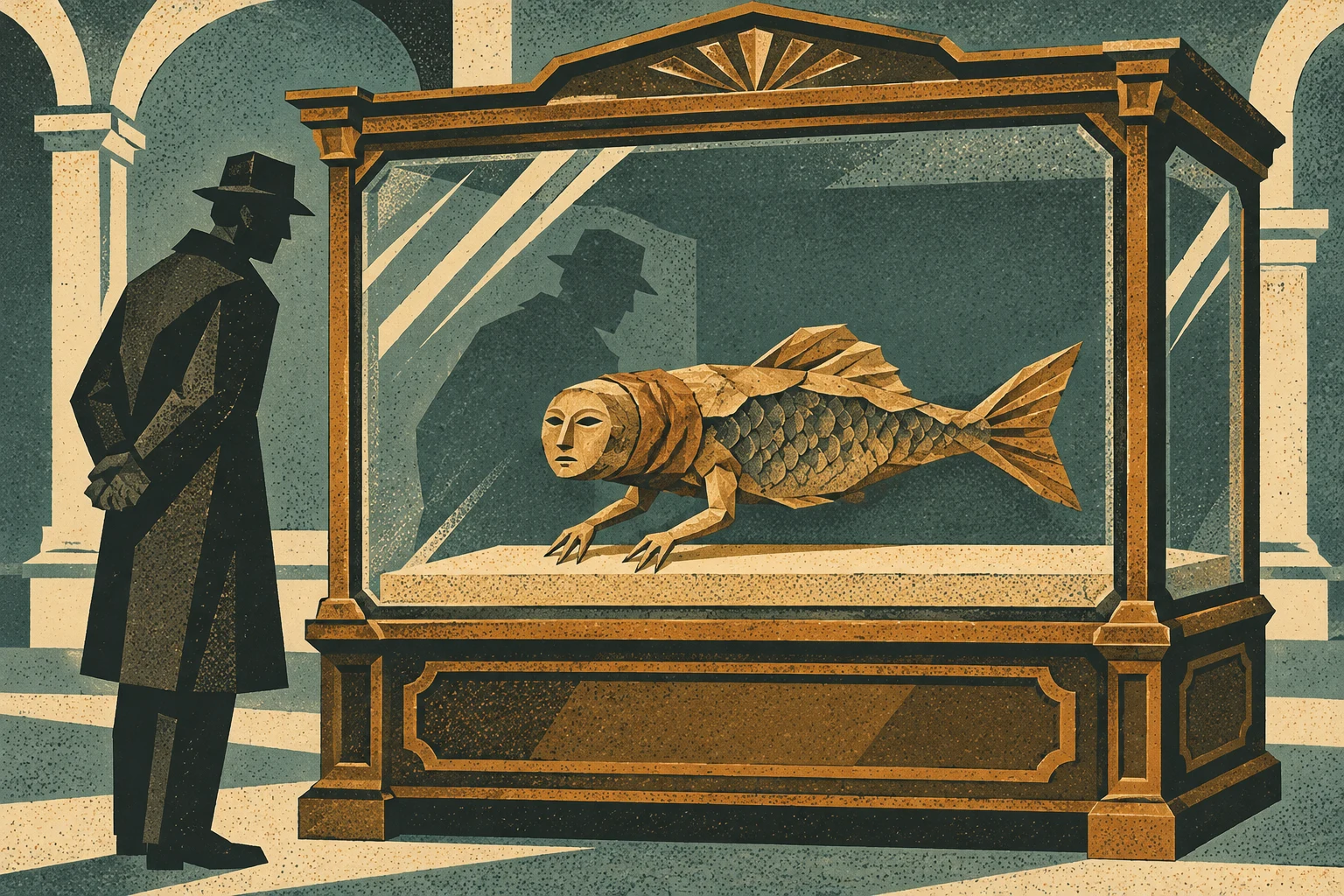
Mermaids under museum lights
The Horniman Museum in London provides a closer technical parallel. Its merman had been recorded as a Japanese monkey-fish. When curator Paolo Viscardi examined the teeth, they failed to match the expected primate mouth. X-rays and CT work revealed a built object, and DNA sampling yielded no useful identification. Investigation replaced an inherited description with evidence of construction.11
The archive then produced a different kind of surprise. A 1919 auction entry described a mermaid with a papier-mâché body, sold as the property of an unnamed officer. The object’s artificial nature had been available in a record before a later label encouraged visitors to imagine a monkey-fish. The officer’s anonymity stopped the ownership enquiry from proceeding much further.11
Viscardi and his colleagues’ published study set that investigation alongside work on a mermaid at Buxton. Their starting problem was familiar: many museums held such objects, but locality information was poor, and interpretations centred on whether they were genuine. Stories about the celebrated Feejee Mermaid had encouraged an assumption that these bodies were all taxidermic combinations of monkeys and fish.12
Their research also followed the dispersal of objects collected by Henry Wellcome. Mermaid bodies had travelled through auction rooms and eventually into different museums, where their classification and interpretation could change. An object might be stored with natural history because it was understood as taxidermy, or treated as a historical curiosity. The category selected by a curator could reinforce an account of its materials that nobody had tested.12
A study published in 2023 examined another example at Milan’s Natural History Museum. This roughly thirty-one-centimetre object had wooden supports and wire in its hands. Folds suggesting a rib cage were sculpted on the surface. Its investigators identified real biological components among the modelled material, while leaving some animal identifications tentative and its early history unresolved.13
Milan’s body differs from Enjuin’s, including its internal support. The comparison demonstrates why the name of the attraction is an unreliable recipe. Similar-looking mermaids can embody different choices about how to make a head, hold up a hand or disguise a join. Each survivor can reward examination even when the broad explanation, a manufactured body, is already apparent.13
These investigations recover labour as well as expose illusion. The maker had to solve practical problems: a recognisable face, a convincing surface, a posture that would survive handling. The materials could betray those decisions long after the workshop had disappeared. Enjuin’s examination placed its anonymous craftsperson back within the object’s history, although no name or place could yet be attached to that work.48
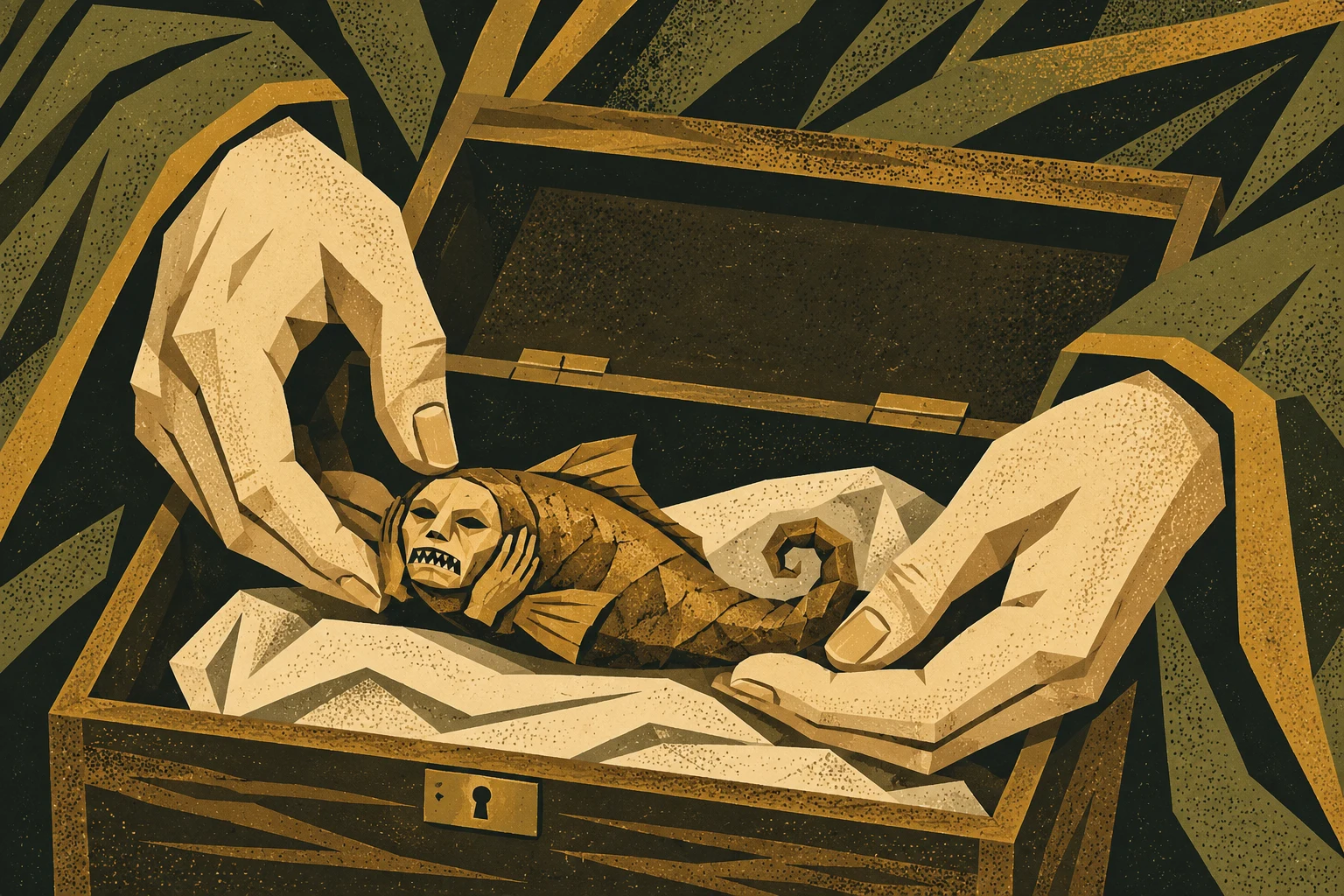
What the temple keeps
The examination also revealed a less theatrical threat than exposure. The 2022 interim report recorded damaged fingertips, peeling nails and torn skin. White patches near the shoulders might have been mould, apparently inactive at the time. Detached debris contained dead mites and insect remains. Researchers recommended a dry, stable storage environment and advice from conservation specialists.6
A made mermaid can decay through its own mixture of materials. Caring for it requires knowing what is at risk, which areas are fragile and how it has been treated. Taken together, the recorded damage and the careful examination explain a practical benefit of the research: knowing how the body was made could help its custodian preserve the features that made it recognisable.
After the final announcement, the priest told KSB that the mermaid carried the feelings of the person who first made it and of those who had inherited and preserved it. His own role was to guard it and pass it on. That explanation did not depend on restoring the claim of a captured animal. It made the object’s succession of human relationships a reason to continue its care.2
As of 7 November 2026, the university’s 2023 analysis identifies a manufactured body, while its maker, workshop and route to the temple remain unidentified.4
The temple keeps both the mermaid and the account of what people once believed they had bought.42
Sources & further reading13
- Scientists try to unravel mystery of eerie mermaid mummy Kunio Ozawa / The Asahi Shimbun · 2022-02-19 · Accessed 2026-11-07
- 「人魚のミイラ」 約1年の研究結果を報告 KSB News · 2023-02-07 · Accessed 2026-11-07
- 里庄町立図書館&円珠院 RSK radio, Kyou no Rajimaru · 2020-08-26 · Accessed 2026-11-07
- 圓珠院所蔵「人魚のミイラ」研究最終報告 Enjuin research team / Kurashiki University of Science and the Arts · 2023-02-07 · Accessed 2026-11-07
- 円珠院所蔵「人魚のミイラ」研究について Kurashiki University of Science and the Arts · 2022-02-09 · Accessed 2026-11-07
- 円珠院所蔵「人魚のミイラ」研究中間報告 Enjuin research team · 2022-03-29 · Accessed 2026-11-07
- 円珠院所蔵「人魚のミイラ」研究 最終報告延期のお知らせ Kurashiki University of Science and the Arts · 2022-09-22 · Accessed 2026-11-07
- Reframing the Human-Fish in the Edo and Meiji Periods: Eroticism, Taxidermy, Oracles, and Modernity Andrea Castiglioni · 2023-05-30 · Accessed 2026-11-07
- Ningyo: Japanese Merfolk and Auspicious Mummies Kimie Itakura / Nippon.com · 2022-05-18 · Accessed 2026-11-07
- Eccentricities of the Animal Creation John Timbs · 1869 · Accessed 2026-11-07
- Manmade Mermaids Paolo Viscardi / Horniman Museum and Gardens · 2014-04-06 · Accessed 2026-11-07
- Mermaids Uncovered Paolo Viscardi, Anita Hollinshead, Ross MacFarlane and James Moffatt · 2014 · Accessed 2026-11-07
- The Milan mermaid Nicolò Bagnasco, Giorgio Bardelli and Luigi Garlaschelli · 2023-09-27 · Accessed 2026-11-07