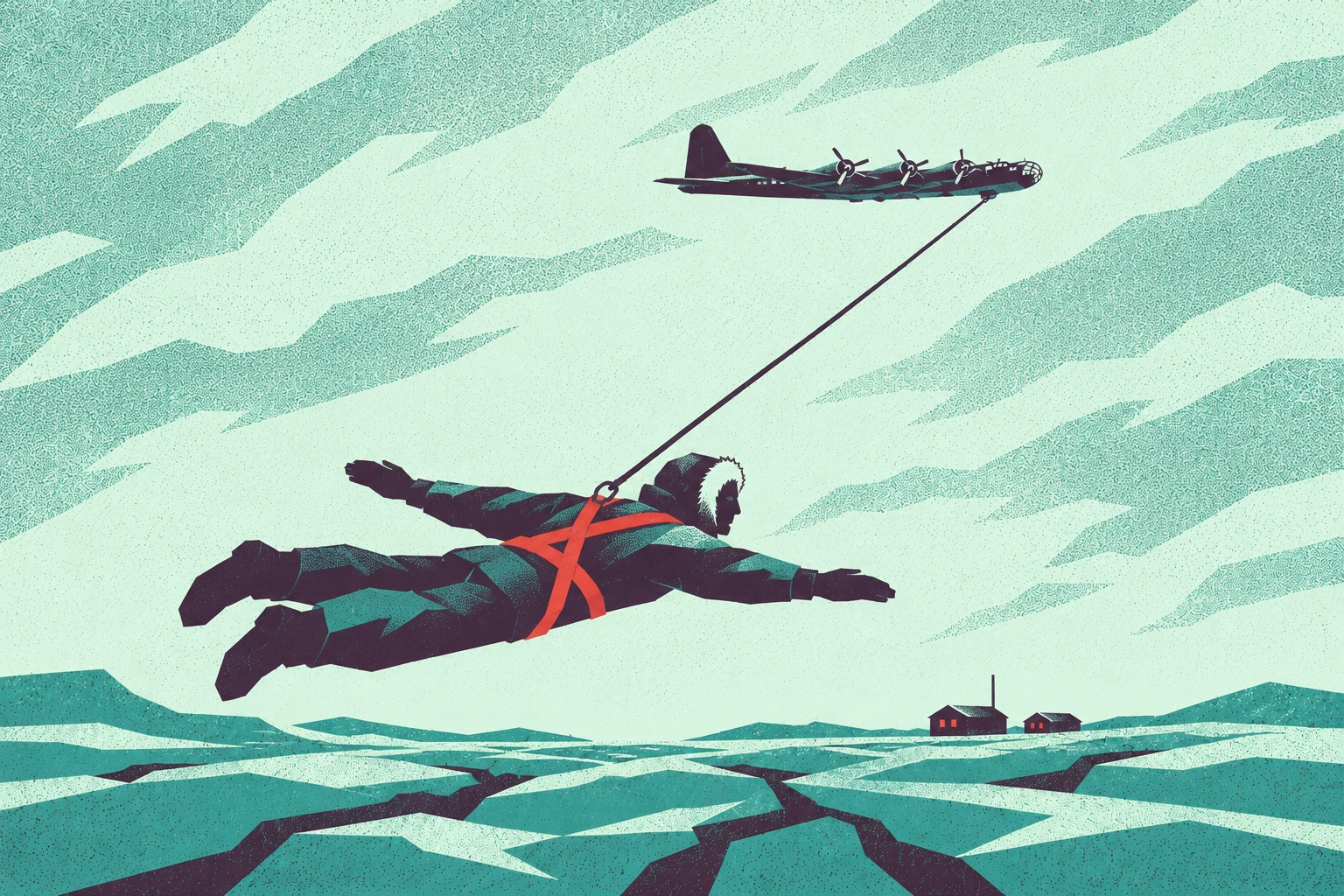
On 28 May 1962, two Americans parachuted onto an abandoned Soviet station in the Arctic Ocean. Their aircraft could not land to collect them, so their way home depended on a balloon, a long nylon line and a bomber flying into it.1
A station without ground
The station was called NP8. Its occupants had departed after the ice around their camp made continued operations unsafe, leaving equipment and research material behind. Major James F. Smith of the United States Air Force and Lieutenant Leonard A. LeSchack of the US Naval Reserve had come to examine what remained. They would both return alive, along with a collection of documents, exposed film and equipment samples. Before that could happen, the aircraft sent to retrieve them would repeatedly fail to find their temporary home.13
A drifting station presented an unusual intelligence opportunity. It was a workplace belonging to an adversary, but nobody had to break into an occupied embassy or persuade a scientist to defect. The people who knew its equipment had gone. Its remaining contents could potentially answer questions that photography from the air could not. The difficulty was reaching them before the same conditions that had driven out the Soviet team made an American investigation impossible.1
The United States and the Soviet Union both maintained research stations on Arctic ice. Their scientists could make observations far from permanent land bases, while the moving platform carried them across the ocean. The work had obvious scientific uses. It also mattered to navies seeking to operate beneath the ice, where knowing the environment could be as important as knowing an opponent's machinery. A research station could serve more than one purpose without every measurement being a military secret.15
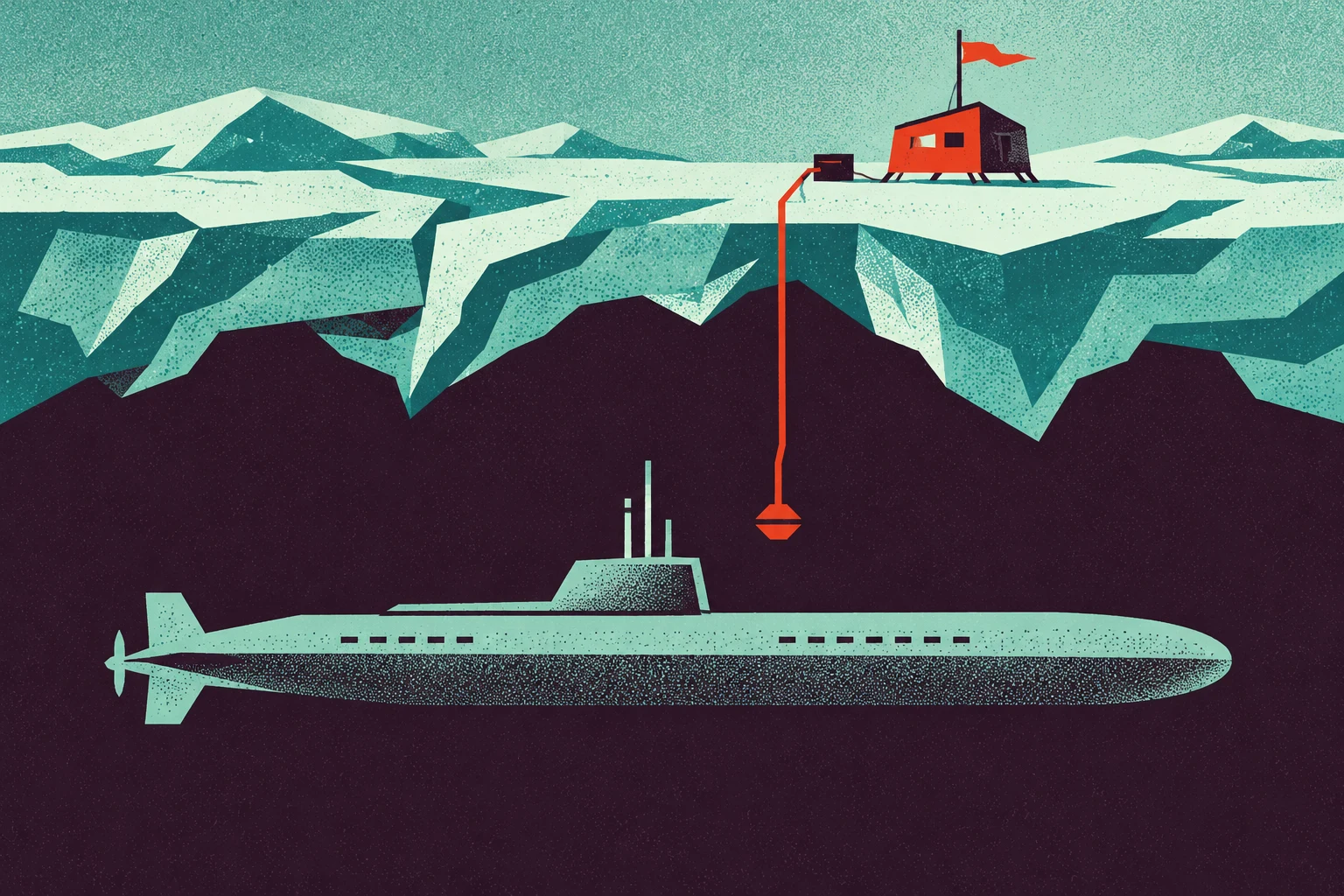
By the early 1960s, nuclear-powered submarines had made the polar ocean a practical area of naval operations. Ice that obstructed a ship at the surface could conceal a submarine underneath. This gave the Americans a particular question to investigate: what could Soviet researchers hear? Detecting a submerged vessel through its sound would turn the ice from a covering into a platform from which an enemy might be watched. American planners wanted evidence of Soviet capabilities, rather than an assumption that Moscow must possess the same techniques.1
LeSchack understood that question from his own work. A geophysicist with polar experience, he had helped establish surveillance equipment on the American ice station T3 in 1960. In an interview published decades later, he recalled proposing an inspection of an abandoned Soviet camp to find out whether its equipment could track American submarines. His idea was to exploit the things a departing expedition would be unable to take away. That retrospective account matches the operation's stated interest in acoustic research.14
Smith brought another combination of skills: experience on American drift stations, Russian-language ability and parachuting. A man examining unfamiliar apparatus needed to recognise what it was; a man searching its paperwork needed to understand what he was reading. Both also had to live and work in an environment that could make the mechanics of collecting intelligence secondary to staying safe. The pair were selected as investigators, rather than simply as passengers willing to attempt an extraordinary pickup.1
Their mission became Project COLDFEET. Its central gamble was straightforward to describe: put two specialists on the ice, give them time to search, then recover them without using a runway. The Soviet evacuation had demonstrated why relying on an ice airstrip was dangerous. The American solution would avoid landing altogether, but it would introduce a different dependency. Everything collected, and each of the men, would have to leave at the end of a line.1
An exit through the sky
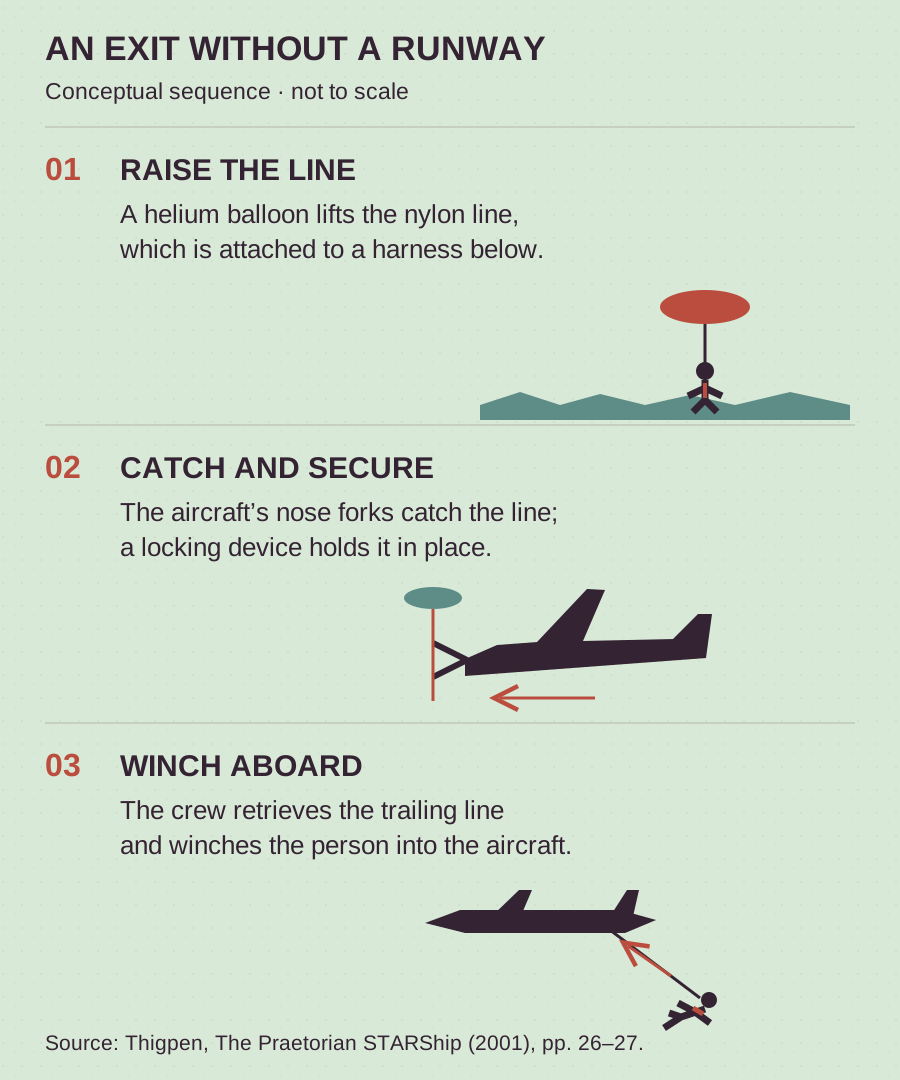
The machine intended to bring them home was Robert Edison Fulton Jr's Skyhook. In its developed form, the person waiting on the ground wore a harness connected to a long nylon line. A helium balloon lifted the line into the air. The approaching aircraft aimed for that suspended target, caught it with a fork projecting from its nose and secured it. The passenger rose from the ground, while the crew brought the trailing line into the aircraft and attached it to a winch.1
That sequence explains both Skyhook's appeal and its limits. A fixed-wing aircraft could travel to a place where there was nowhere suitable to land. The ground party could receive its recovery equipment by parachute, rather than needing an elaborate installation built in advance. But capturing the line was only one stage. A successful operation also required the person to be lifted safely, the line to be handled correctly and the passenger to be brought through the aircraft's opening without losing the connection.1
Earlier aerial pickup systems had used a line suspended between poles, drawing on techniques for collecting mail. They offered an answer to a longstanding problem: parachuting somebody into an inaccessible place was easier than bringing them back. Fulton replaced the low suspended target with a balloon-supported line and developed an aircraft-mounted catching mechanism. The balloon carried the line, not the passenger. It was the aircraft that supplied the force needed to lift and recover the person below.1
Fulton's experiments began in 1950. Refining the idea involved more than finding a rope strong enough for a person. The line had to be caught reliably, held while its load came under tension and subsequently released from the nose mechanism so that the crew could complete the recovery. Thigpen's Air University history describes the development of the locking device, known as the sky anchor, as a crucial part of making the system workable. A secure catch that could not be managed afterwards would not solve the extraction problem.1
By 1958, the basic arrangement had taken shape. The Navy's modified P2V aircraft carried projecting steel forks; the ground package included a harness, helium supply and a 500-foot line. A visible marker gave the pilot an aiming point below the balloon. Tests progressed from loads and instrumented dummies to living subjects. On 12 August 1958, Marine Staff Sergeant Levi W. Woods became the first person recovered by the Fulton system. A human pickup was therefore an established test procedure before COLDFEET was proposed.1
Arctic trials followed in 1960. They included collections from ice station T3 and a pickup from the deck of the icebreaker USS Burton Island. Those trials mattered because success in a convenient test area did not establish that the system could work in polar conditions. They also demonstrated that the recoverable load need not be a person. Skyhook could bring out the equipment or records that made an intelligence visit worth attempting, as well as the investigators sent to find them.1
A reliable procedure still required a trained team. The pilot had to approach the line correctly, while the recovery crew handled the changing load and transferred it to the winch. The person below had to wear the harness and assume the appropriate position. LeSchack and Smith practised with the system at Patuxent River in Maryland. LeSchack also acquired the parachuting skills he had not previously needed. Their preparation addressed two very different transitions: leaving an aircraft and returning to one without a landing.1
COLDFEET would test the entire chain at once. There would be no friendly runway beside the people waiting for recovery, and no guarantee that the weather at the station would resemble conditions at the departure base. The invention removed one obstacle, but it could not make the Arctic a predictable place. Before Smith and LeSchack ever reached NP8, that distinction nearly ended the operation.1

A target that would not wait
NP8 was not the original destination. In 1961, the Americans became interested in another abandoned Soviet station, NP9, after a naval aircraft sighted it and the Soviet departure became known. The Office of Naval Research began preparing a visit. The numbering is an easy source of confusion: the operation first considered Station Nine, then eventually inspected Station Eight. The change reflected an available target, rather than a sequence in which the Americans worked their way through neighbouring camps.1
Initial planning envisaged a September 1961 expedition launched from Thule in Greenland. Captain John Cadwalader would command the operation, with the scientific opportunity and the new pickup system providing reasons to proceed. Approval took time, however. Senior officers questioned whether the mission could succeed and whether the risks to its investigators were acceptable. By the time final permission arrived, the intended seasonal window was closing. An intelligence opportunity on moving ice could become less accessible while officials discussed it.1
Equipment created further delays. Cold-weather testing at Eglin Air Force Base exposed problems that had to be corrected before the mission could go ahead. That was a practical warning against treating a successful demonstration as proof that every part of the operation was ready. The station continued to drift while the Americans solved problems ashore. Winter conditions then helped push the attempt into the following year. NP9 had not remained conveniently in place for its visitors.1
News of NP8's abandonment in March 1962 revived the plan around a newer target. The Americans obtained permission to operate from the Royal Canadian Air Force base at Resolute Bay. A Skyhook-equipped Navy P2V and a supporting C130 were sent north in April. The C130 would search for the station and carry the investigators; the P2V supplied the means of recovery. On paper, the operation now had a destination, a departure base and aircraft suited to its two principal tasks.1
The station was missing from the place where the searchers expected to find it. The C130 flew to its last known position and searched outward in a box pattern. A second search tightened the spacing between the aircraft's tracks. More flights followed, but the camp did not appear. Clear weather could not compensate for searching the wrong part of a moving surface. After the allocated flying time had been exhausted, the expedition was called off without putting either investigator on the ice.1
Subsequent reconnaissance found NP8 east of the area that had been searched. The target still existed, but the Office of Naval Research no longer had the money needed to pursue it. COLDFEET's next obstacle was financial. Fulton was already working with Intermountain Aviation, a CIA-owned company that had fitted a B17 with Skyhook equipment and practised aerial recoveries. Its pilots, Connie Seigrist and Douglas Price, could supply another route to the station if the operation found support.1
The Defense Intelligence Agency provided an initial $30,000. Intermountain supplied the modified B17 and a C46 support aircraft, giving the mission a new operational arrangement. The successful attempt would begin from Point Barrow in Alaska. Changing the base and aircraft did not remove the original problem: the Americans still had to locate a small abandoned installation amid a great deal of ice. On 26 May 1962, the aircraft reached Alaska and the search began again.1
Seventy-two hours
The first B17 search was another failure. On 27 May, Seigrist and Price spent about thirteen hours in the air without locating NP8. A conventional description of an intelligence target suggests something fixed: a building, an airfield or a shipyard. Here, the object of the mission was itself travelling. The searchers needed to find a camp whose last reported position was already historical information, while poor visibility made recognising it more difficult.1
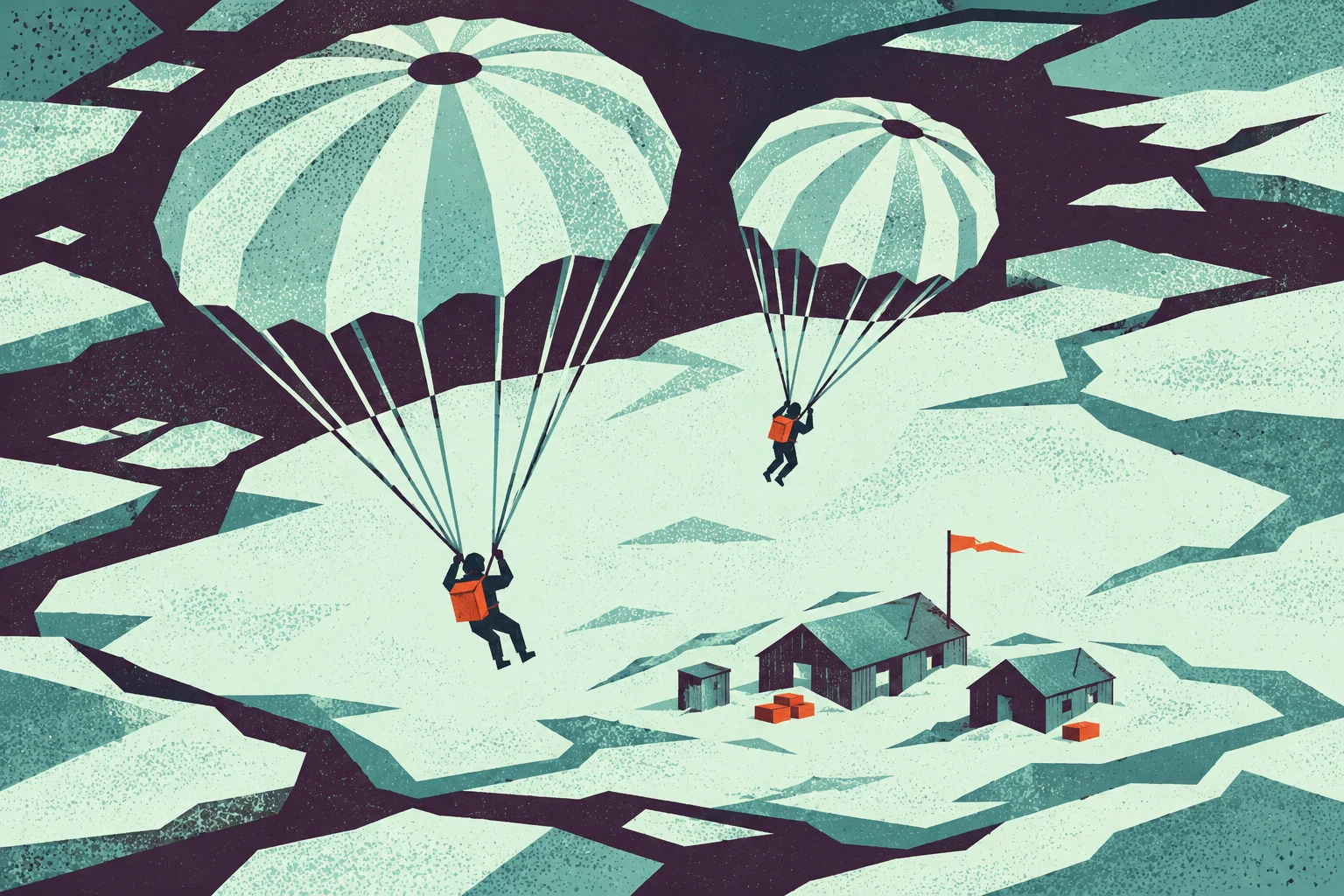
On 28 May, assistance from a Navy P2V helped the B17 locate the station. Smith and LeSchack could finally make their jump. They left through an opening in the aircraft's belly, the kind of exit associated with earlier clandestine parachute operations. Supplies followed them down. Once the ground party had reported by radio, the B17 departed. The men were now at their destination, with their return dependent on another aircraft finding it again.1
The plan allowed seventy-two hours for the search. They photographed the installation and collected material for examination elsewhere. A drift station was useful because equipment and working arrangements could reveal more together than either could in isolation. An instrument might show how a measurement was made; records could identify what its operators had considered important. Photographs could preserve relationships between things too large or cumbersome to remove. This was a technical inspection, rather than a hunt for a single dramatic document.13
The surviving public summaries describe the eventual collection broadly: exposed film, documents and equipment samples, weighing around 150 pounds. They do not provide a complete inventory in the accounts used here. It would therefore be misleading to furnish the huts with a newly invented list of secret charts, codebooks or listening devices. The material was substantial enough to require its own recovery, but its weight does not tell us how many individual discoveries the pair made.13
Their expertise shaped the opportunity. Smith could read Russian material without sending every decision back to a distant translator. LeSchack could examine a polar installation with experience of comparable American work. The Americans had not simply found abandoned property: they had placed people capable of asking informed questions beside it. The mission depended on selecting evidence within the time available, rather than carrying every object away and hoping an analyst would later discover what mattered.1
The abandoned station also had a history before it became an American intelligence target. A Russian State Library catalogue records a substantial volume of scientific observations from NP8 and NP9 in 1960–61, published in 1964 under the editorship of K. A. Sychev. That catalogue does not reveal the contents of the Americans' collection, and the volume has not been examined for this article. It does establish that these stations generated a public scientific record as well as attracting secret attention.5
While Smith and LeSchack worked, Intermountain's mechanics prepared the B17 for recovery and tested the pickup installation at Point Barrow. The intended return visit was 31 May, three days after the drop. Nothing in the plan required the aircraft to touch the ice. It did, however, require the crew to see enough of the station and its pickup line to approach safely. The weather was about to make that requirement considerably harder to meet.1

Lost in grey
The B17 could not find the station on 31 May. Fog obscured the target, forcing the aircraft back to Alaska without the two men it had come to collect. A further attempt on 1 June also failed. The crew had already demonstrated that they could deliver the investigators. They now had to repeat the navigational success under worse conditions, while carrying the equipment needed to bring the pair home.1
The delay did not mean the men had disappeared, or that the station had suddenly broken apart. The released history describes unsuccessful attempts to locate it from the aircraft. That distinction matters in a story easily turned into a survival legend. There was no documented Soviet pursuit in these accounts, no attack on the camp and no need to invent a final emergency message. The danger lay in the known limits of the recovery plan and the difficulty of reaching the waiting party.1
A balloon could raise a line above the ice, but the presence of that line did not make the surrounding terrain easy to judge. The pilot needed enough visual information to control the approach and enough confidence in the aircraft's position to avoid a collision. Fog could conceal the camp outright. Even when the target became visible, a weak or absent horizon could make level flight difficult to assess by sight. Skyhook's precision requirement survived the disappearance of the runway requirement.1
On 2 June, the Americans again brought in the P2V to help locate NP8. It departed ahead of the B17, allowing its search to take place before the pickup aircraft arrived. The P2V found the station and guided the other aircraft towards it. This was a significant part of the mission's eventual success: the celebrated recovery depended on help from a second aircraft, rather than on the B17's crew overcoming every problem alone.1
Conditions over the camp remained poor. Thigpen's history records winds of about thirty knots and a horizon that was hard to distinguish. In these circumstances, the ground party had to inflate and control the balloons while preparing the loads. Before a plane caught anything, the wind acting on a balloon could pull the attached cargo or person across the ice. An invention designed to lift a man had become difficult to keep still.1
They would need three recoveries. First came the bag containing the collected material. LeSchack would follow, then Smith. The arrangement left the final man to prepare his own pickup after the other had gone. Both investigators had practised the procedure, but neither could rely on a second pair of hands throughout it. Each successful pass would bring the operation closer to completion while changing the situation for whoever remained below.1
Three loads for the aircraft
Seigrist made the first approach. The canvas sack contained the material that had justified the expedition, and its balloon was already exerting enough pull for the men to struggle to restrain it. The B17 caught the line, and the crew brought the cargo aboard. Recovering the evidence established that the system could work in the conditions over NP8. It did not establish that the two human recoveries would be equally straightforward.1
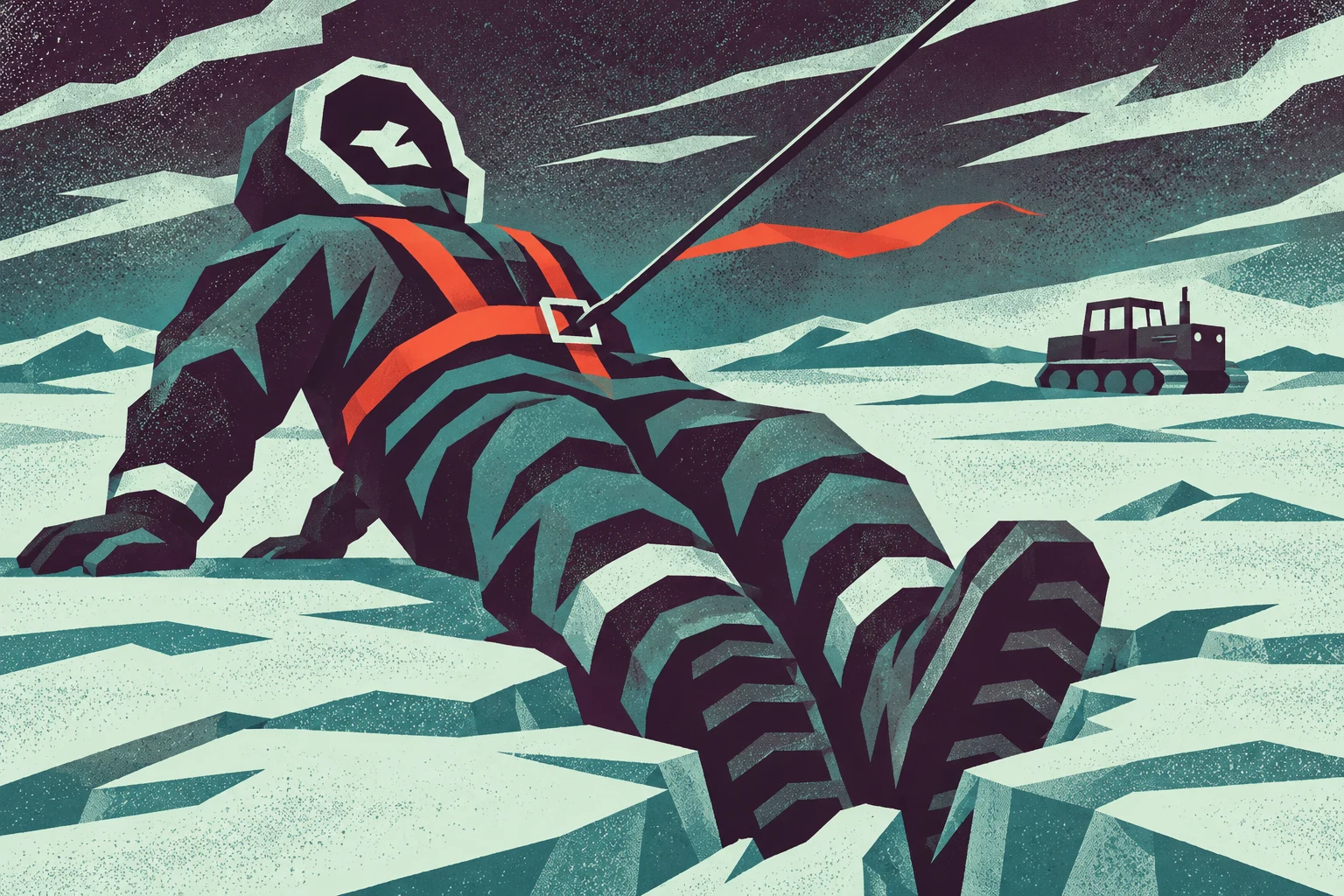
Price took the controls for LeSchack's pickup. As the balloon rose and caught the wind, Smith could not keep his companion in place. LeSchack fell forward and was dragged across the ice. The released operational history gives the distance as roughly three hundred feet before an ice block stopped him. He was still below the aircraft, with the recovery line pulling at him, when Price flew into the target.1
LeSchack's later recollection supplies a particularly uncomfortable detail. His face covering shifted during the ordeal, restricting his vision, and he found himself incorrectly orientated as the pickup developed. Once airborne, he used his arms to help turn his body until his back faced the airflow. This is participant testimony given many years later, rather than a contemporary instrument record, but it describes why getting into the air did not necessarily end the difficulty.4
The sources differ on some details of the wind and the sequence of movement. LeSchack's interview remembers lower wind speeds than the thirty knots given in the operational history. There is no sound reason to average the figures or pretend that they are identical observations. The common ground is more important: the balloon pulled him along the surface, he was lifted in an awkward position and he had to correct himself before being brought aboard.14
Smith was now alone on the ice. He used a tractor as something to hold while preparing his balloon. Even so, the wind began dragging him too. He stopped himself by catching the heels of his boots in a crack and lay on his back waiting for the aircraft. The very surface that had made continued station operations hazardous now provided the small purchase that kept the last investigator from sliding farther away.1
Seigrist returned to the controls for the final pickup. The aircraft caught Smith's line, and the recovery crew brought him aboard. At that point, the essential result was unambiguous: both investigators and their collection were off the ice. The operation had not required a landing, and the aircraft had completed three separate recoveries in conditions that pushed beyond the comfortable limits of the method. The failure of either human pickup would have left a very different history.1
Skyhook is often explained as though the entire achievement belonged to the moment when a fork met a rope. The rest of the sequence deserved equal attention. The load had to remain attached while the line was transferred and drawn in. A person suspended behind an aircraft still needed to enter it. Pilot skill, ground preparation and the work of the recovery crew were parts of a single operation, with no stage made unnecessary by success at the previous one.1
Nor did the outcome prove that the equipment had been safe in every respect. Later versions included ground-anchor equipment, with provision for ice and frozen soil, to restrain the waiting load when winds made that necessary. Thigpen explicitly connects that development with lessons from COLDFEET. The mission had demonstrated a useful capability while also exposing a problem that its own participants had encountered directly. Improvement followed experience, rather than merely confirming that the original arrangement needed no alteration.1

What the ice gave up
What had made the journey worth the risk? The released American assessment points to a station arranged for extended periods of low-noise operation. That was significant to investigators interested in listening beneath the ice. Quiet working conditions would be valuable if unwanted machinery noise interfered with acoustic observations. The inspection therefore gave the Americans evidence about how Soviet researchers had organised the station, rather than simply reinforcing a suspicion from afar.1
The conclusion still requires careful wording. A station configured for quiet operation is not the same thing as a published demonstration that it could identify every American submarine passing through a particular area. The public accounts used here do not supply a complete set of detection trials, ranges, recognition rates or recorded submarine contacts. They establish an American judgment about the importance of Soviet acoustic work. They leave the reader with less detail about the system's demonstrated performance.1
The Americans also judged Soviet work in polar meteorology and oceanography favourably, describing aspects of it as ahead of their own efforts. That finding complicates a simple picture of the camp as a military disguise. Useful intelligence included learning how an opponent conducted scientific work and maintained an installation in a demanding environment. A successful collection could reveal an advantage to be studied, rather than a secret weapon to be dramatically unveiled.1
There is no contradiction in a research station producing published science while holding information a rival navy wants to inspect. The Russian catalogue record of NP8 and NP9 observations documents the first part; the American mission documents the second. Neither by itself tells us the military status of every instrument or every person who worked there. Treating the whole camp as fraudulent science would claim more than the available evidence supports.15
The provenance of the account also matters. Thigpen's military history draws its COLDFEET narrative from William M. Leary's earlier work. Leary, in turn, consulted participant accounts and an operation report by Cadwalader. These are useful sources, but repeating their conclusions in multiple later histories does not create multiple independent discoveries. Much of the familiar story travels along the same documentary chain, supplemented by recollections from people involved.12
Leary was unusually clear about one limitation. In a note to his account, he explained that descriptions of the May and June events differed in some details and that his reconstruction used the sequence he considered most logical. That caveat does not cast doubt on the existence of the operation or its successful recovery. It warns against treating every finely timed movement in a popular retelling as though it came from a single complete contemporary transcript.2
A fuller assessment would need the recovered material and the original technical analysis, read alongside Soviet records of the station's work. The broad released conclusions cannot stand in for that comparison. For a general history, the responsible position is sufficiently interesting: the Americans found equipment and arrangements they considered valuable, recovered them through a difficult operation and gained a better view of Soviet polar research. The public narrative does not reveal every question that the analysts subsequently asked.12
A success with limits
COLDFEET gave Skyhook an operational demonstration beyond its controlled tests. The system had taken people from a place where conventional collection by aircraft was unavailable. The successful return also gave the American intelligence agencies a story of technical ingenuity, co-operation and persistence after repeated setbacks. In that account, locating the camp, financing the attempt and handling the aircraft were as consequential as the invention that made recovery possible.1
The technology did not become a guarantee of safety. Thigpen records a fatal accident during a later training pickup in 1963, when a recovered person was disconnected before being safely secured inside the aircraft. That death was not part of COLDFEET, and should not be added to its casualty count. It demonstrated the importance of the final handling stage, after an apparently successful catch had already brought somebody to the aircraft.1
Later military versions adapted the system to other aircraft and refined its equipment and procedures. The conspicuous projecting forks make an arresting photograph, but the less visible changes mattered too: managing the line, keeping it clear of hazards and controlling the waiting load on the ground. COLDFEET belongs in that development as a demanding early use, with lessons to carry forward, rather than the moment aerial extraction became effortless.1
In 2008, participants were honoured at CIA headquarters at the unveiling of Keith Woodcock's painting of the operation. Painted in 2007, it depicts a B17 making a pickup over the ice. It is a retrospective commemoration, not a contemporary image of the event. The agency's museum presentation places the mission within its own tradition of resourcefulness, celebrating a result that many of the participants' families had not previously known in detail.3
As of November 2026, the public sources examined for this article support a clear operational outcome and a more limited technical one. Smith and LeSchack reached NP8 on 28 May 1962 and were recovered on 2 June with material the Americans valued. The published summaries explain the broad intelligence findings, but do not provide an item-by-item view of the collection or a technical measure of what it proved about detecting submarines beneath the ice.123
Follow the evidence
Sources & further reading
- The Praetorian STARShip: The Untold Story of the Combat Talon Jerry L. Thigpen / Air University Press · 2001-12 · Accessed 2026-11-07
- Robert Fulton’s Skyhook and Operation Coldfeet William M. Leary / Studies in Intelligence · 1995 · Accessed 2026-11-07
- Seven Days in the Arctic CIA Museum · Accessed 2026-11-07
- Leonard LeSchack: Spy, scientist and Navy captain Don Otis / Sandpoint Magazine · 2015 · Accessed 2026-11-07
- Observations of drifting research stations North Pole 8 and North Pole 9, 1960/61: catalogue record Russian State Library / Arctic and Antarctic Research Institute · 1964 · Accessed 2026-11-07