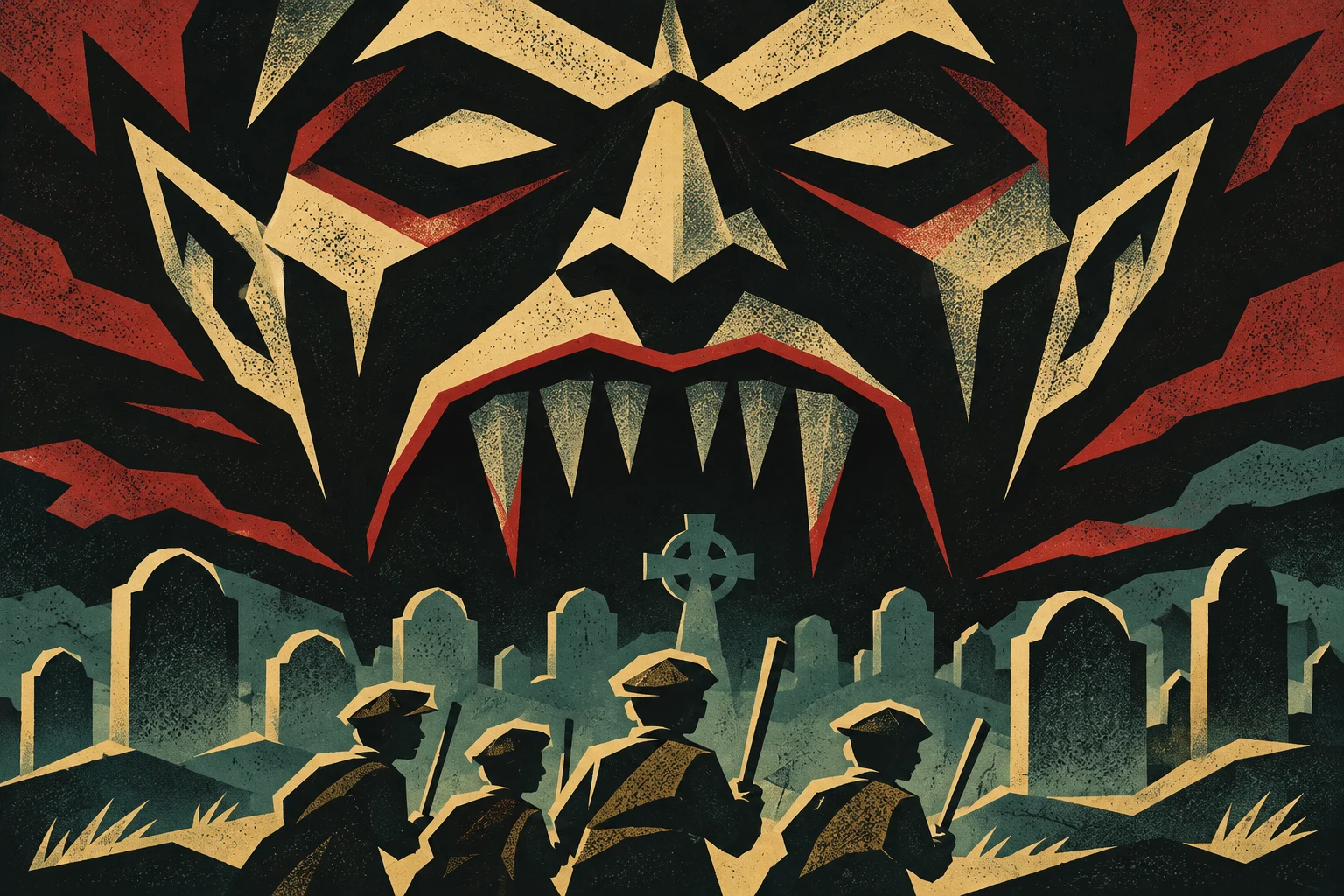
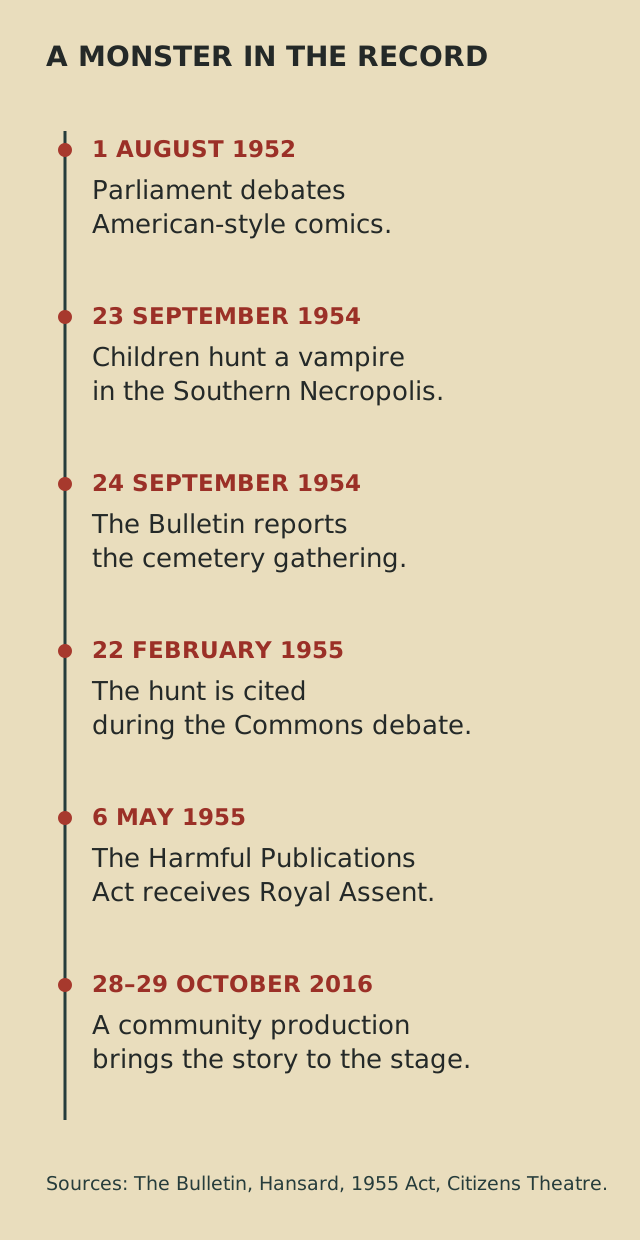
On 23 September 1954, hundreds of children searched a Glasgow cemetery for a vampire with iron teeth. Police found a real crowd pursuing a monster said to have eaten two boys, but the alleged victims never became an established murder case.17
Hunters among the graves
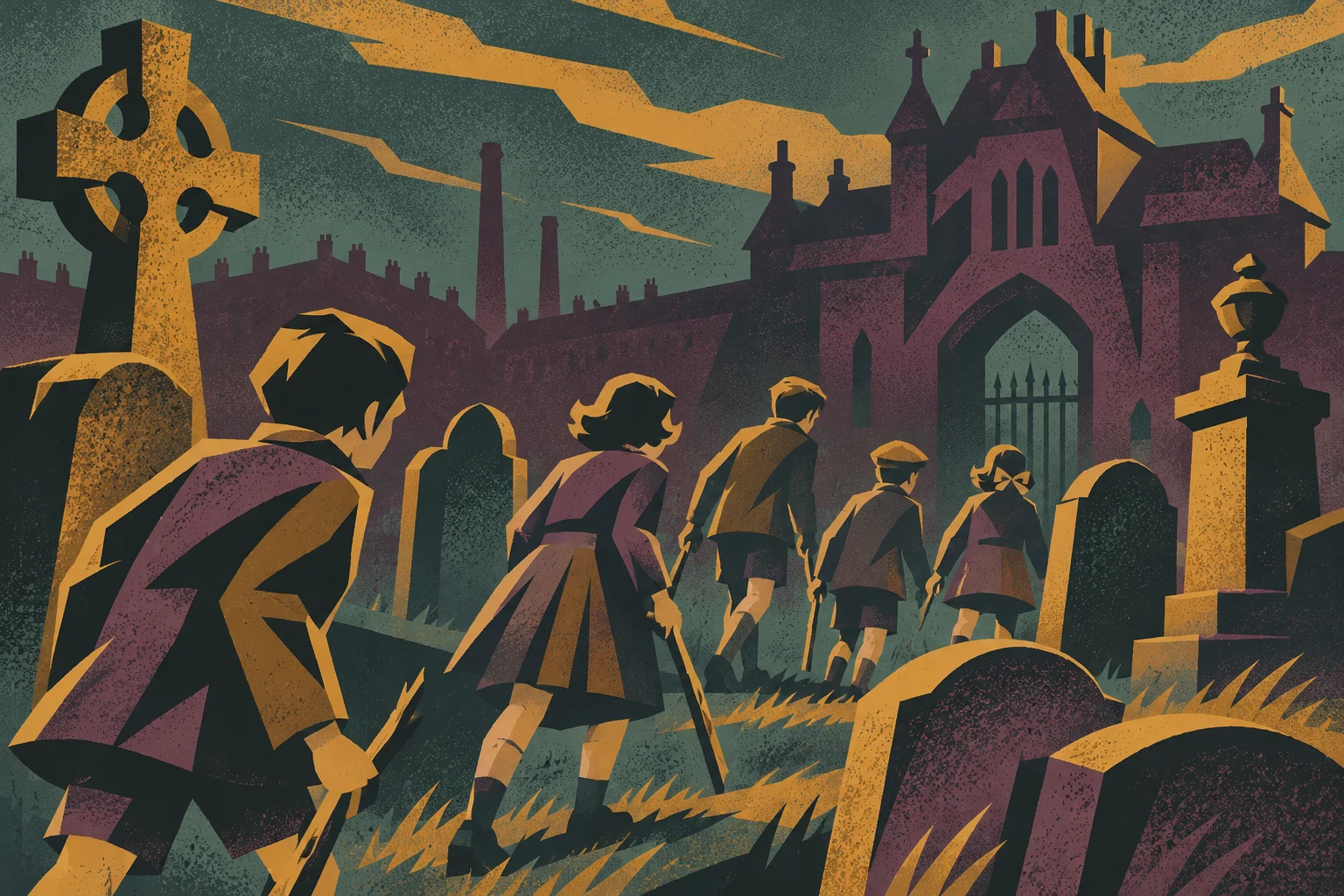
Residents of Caledonia Road complained about children climbing into the Southern Necropolis. The Bulletin reported youngsters from across Hutchesontown, some carrying sticks or stones, who intended to kill a vampire. The police had been called to a real gathering, whatever its quarry.1
The place was substantial enough to give a rumour room to grow. The Southern Necropolis opened in 1840 and became the burial ground of generations of Glaswegians. Its heritage organisation records more than a quarter of a million interments. This was a real cemetery within the children's city, with walls, entrances and monuments through which a search could move. It should not be confused with Glasgow's other, better-known Necropolis, across the Clyde.4
The remembered monster was much more specific than a nameless ghost. Folklore Scotland's account describes a seven-foot figure with iron teeth, accused of kidnapping and eating two boys. Those were properties of the circulating story, rather than a description established by a recovered body or an identified eyewitness to a killing. The distinction is present at the beginning of the case. The hunt is documented; the creature's supposed victims belong to the allegation that gave it urgency.5
An adult arriving at the cemetery therefore faced two different questions. Were children gathering, armed and frightened or excited? The contemporary report supplies ample evidence that they were. Was their account of the danger true? A crowd could repeat the same story without producing an independent witness to the event it described. Numbers made the search an immediate practical problem, but did not establish that something with iron teeth was waiting among the graves.
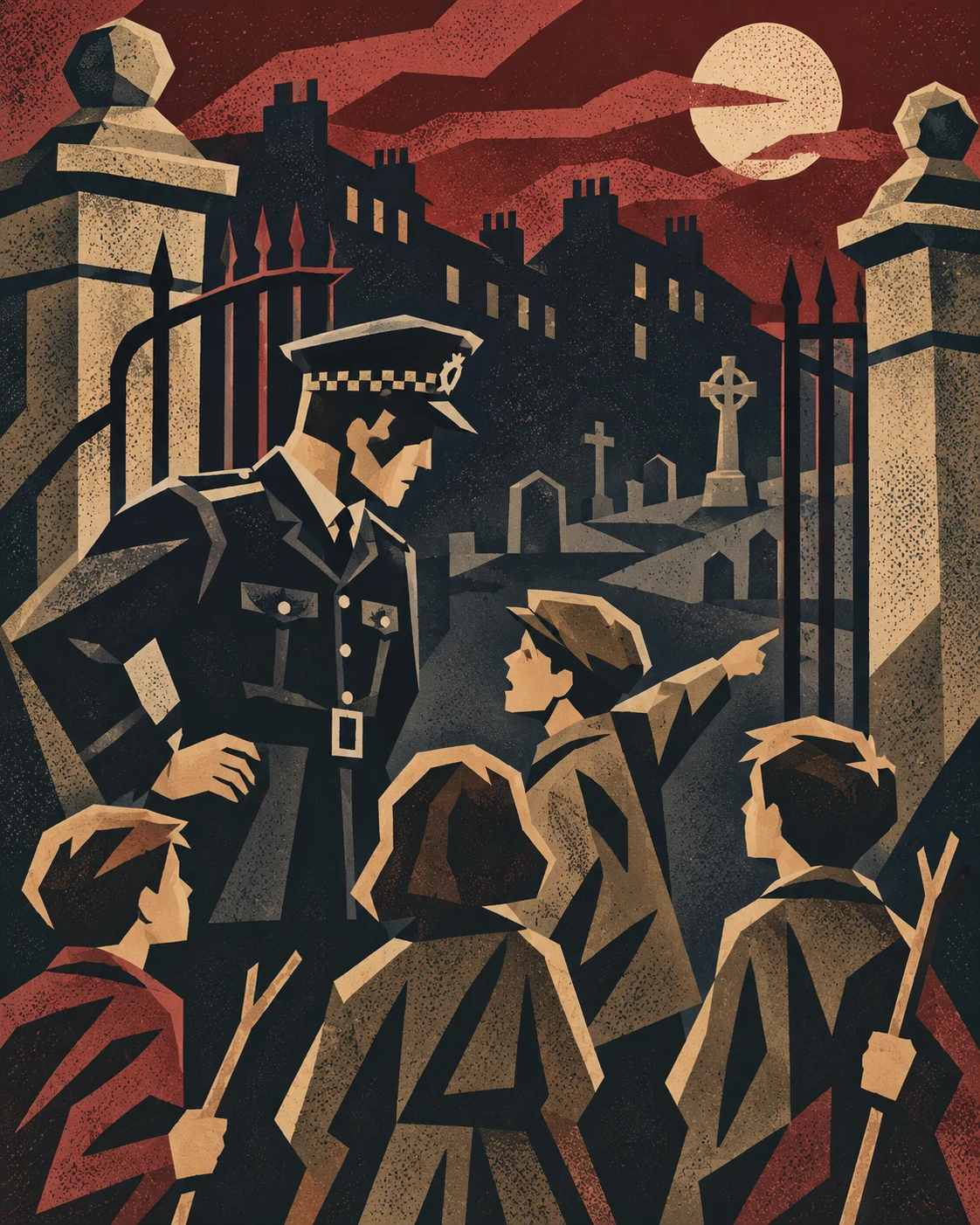
Constable Alex Deeprose faced children talking at once and adults asking whether the story might be true. Darkness and rain helped clear the crowd. The Bulletin reported a disturbance, without establishing the alleged killings.1
Later versions add detail and atmosphere. Spooky Scotland, for example, recounts the involvement of a local headmaster and places the cemetery within the industrial landscape dominated by Dixon's Blazes. Such retellings preserve how the episode came to be remembered: a frightening burial ground, children acting together and adults trying to restore order. They should not be silently converted into an exact account of what every child saw, heard or believed on that September evening.6
The appeal of the story lies partly in the children's direction of travel. They were moving towards the place where the danger was supposed to be. Whatever mixture of fear, curiosity, bravado and play each participant brought, the group had made an accusation into a mission. The police could clear a cemetery. Clearing away the explanation that the adults would attach to the hunt proved a much longer business.
A monster makes the papers
The route from graveyard to newspaper was reconstructed decades later by Sandy Hobbs and David Cornwell. They interviewed Deeprose and the original reporter, Malcolm Nicolson, in 1985. In their account, Nicolson had telephoned Lawmoor Street police station on his regular search for news, initially heard that nothing was happening, then learnt about the vampire. Their research separates the gathering itself from the decisions that made it a news story, and later a political example.2
The first report, on 24 September, describes the disturbance and ends with a local horror-film suggestion. It does not identify a horror comic as the source. The explanation which later dominated the case was absent from this earliest account.1
The Bulletin returned to the story on Saturday 25 September under a headline reporting that the vampire hunters were out again. The surviving excerpt in the researchers' comparison attributes the comics explanation to local mothers. It is evidence that the search continued and that an explanation was being offered. It is not a record of investigators tracing the rumour backwards to a particular child reading a particular page.25
By Monday, the paper was presenting a different ending: the vampire no longer frightened the children. That was the framing of a newspaper item, rather than a survey of everybody who had attended. Even so, it shows that the immediate episode was already being rounded off. A crowd had formed, returned and dwindled. The story could have ended there, leaving an unusual police incident and memories among those who had gone looking.26
Another paper found a wider use for it. The Daily Record's coverage, charted through contemporary excerpts, placed the vampire alongside arguments about horror comics and their effects on children. The sequence moved from a local occurrence towards material supporting an existing campaign. A reader did not need an explicit declaration that comics had caused the hunt: stories about the two subjects, repeatedly placed together, invited that conclusion.27
By 1 October, the Catholic Observer was stating the connection directly in the passage reproduced by Hobbs and Cornwell. Its report described lurid American comics as having thrown the children into fear. That is valuable contemporary evidence of the accusation. The claim itself still required investigation. Neither strong wording nor a front-page position supplied the missing route from a published story to the children at the cemetery.28
The progression is more revealing than a simple claim that the newspapers invented everything. Reporters had a real event to describe. Campaigners had real publications to criticise. What changed was the relationship asserted between them. As the story travelled, a possible influence acquired the force of an explanation, while the practical question of what these children had actually read remained unanswered.
The comics already on trial
Britain was arguing about American-style comics well before the Gorbals hunt. A Commons debate on 1 August 1952 discussed their circulation and what the government could do about them. The official response distinguished controlling admission to a cinema from restricting the sale of printed material, warning of the broader censorship that a system of licensing publications might entail. The problem had already reached Parliament more than two years before the cemetery filled with children.14
That earlier debate puts the later story in its proper order. The vampire did not create national concern about children's reading. It offered a vivid example to people who were already looking for evidence that intervention was necessary. A frightening title, a gathering of children and a police response made the case easy to retell. They were much more memorable than an argument about definitions or the uncertain relationship between a reader and a fictional character.
The Comic Book Legal Defense Fund's later account places the scare within that campaign and emphasises the gap between the reported vampire victims and reality. It also describes how the story passed from the local press into national attention. The organisation's purpose is to defend comics and their readers, so its account has a clear perspective. Its central historical distinction remains useful: what a campaign said the hunt demonstrated is different from what the occurrence itself proved.7
There was a genuine difficulty behind the political argument. A disturbing publication need not produce a literal imitation before an adult worries about its effect. A child might be frightened by a picture, a description from somebody else or a story whose source has been forgotten. Requiring a simple copy of an illustrated event would be too narrow a test of influence. Equally, the presence of fear cannot identify the publication that supposedly produced it.
Hobbs and Cornwell returned to the subject in their conference paper The Science and Politics of Play. They contrasted the attention given to the vampire with a different reported episode in which children had harassed a travelling family. Their point was about the selection and interpretation of children's behaviour: some events became persuasive public examples, while other troubling events slipped from view. The vampire's place in the comics dispute helped make it prominent and enduring.3
That comparison also limits the comfortable version in which the hunt was merely a splendid adventure. Children carrying improvised weapons and moving as a crowd could alarm the adults around them, even when their target was imaginary. It is possible to recognise that concern without accepting the explanation chosen for it. The question is what the evidence allows a writer to say about the source of the rumour and the behaviour that followed it.
A search through comics could answer one important part of the problem: had anyone published a suitably close story before September 1954? It could not, on its own, explain why so many children went to that particular cemetery. The older campaign supplied an adult interpretation. To understand the monster itself, investigators also had to look beyond the newsagent's shelves.
Jenny at the bedroom door
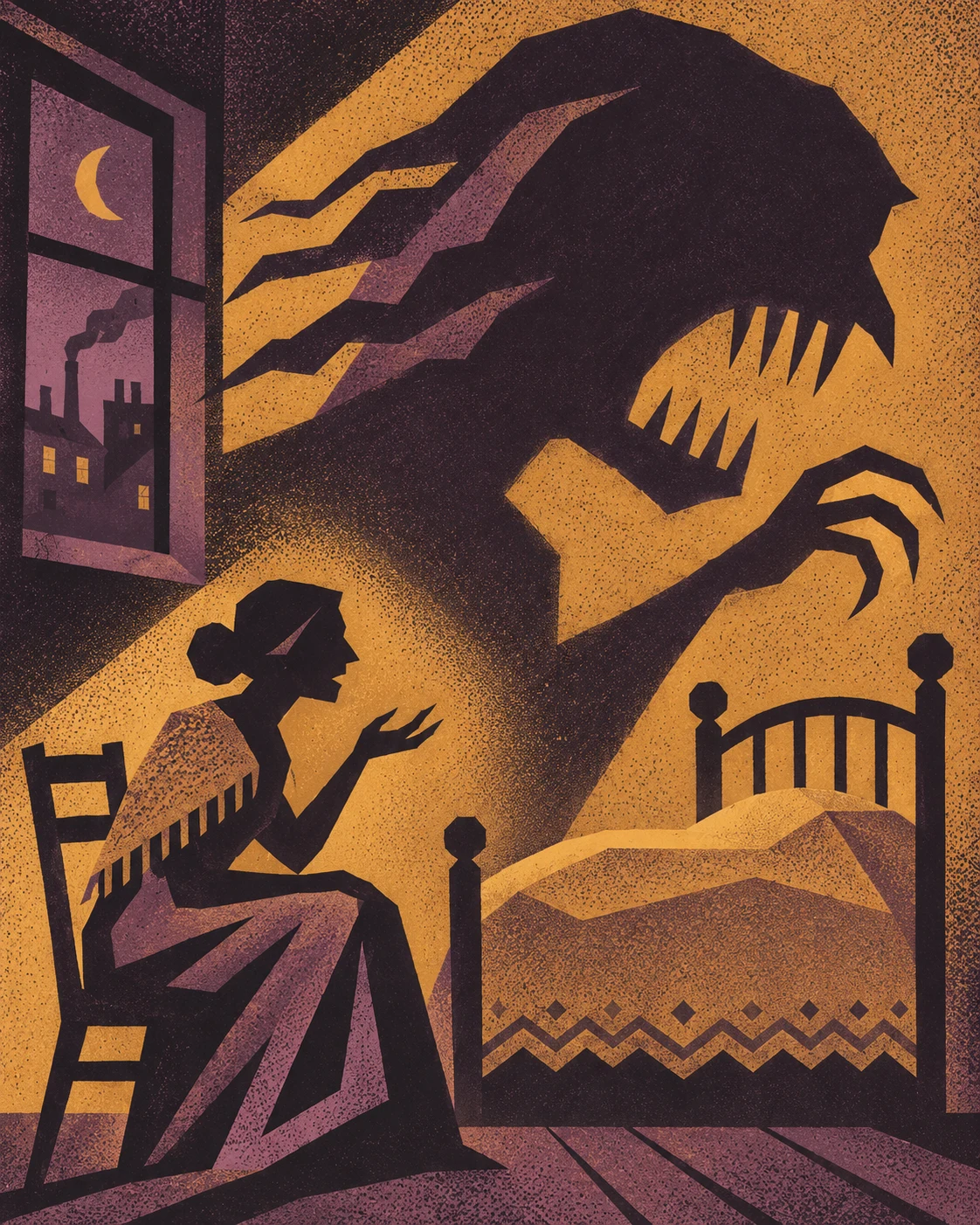
An iron-toothed threat already existed in Scottish literature. Alexander Anderson's Jenny Wi' the Airn Teeth appeared in his Ballads and Sonnets in 1879. The poem begins with a mother trying to settle a wakeful child while she has work to finish. She calls upon a bogey to take the child away. The threat becomes a presence at the door, and the mother draws the child close before sending Jenny elsewhere.8
Jenny wi’ the airn teeth, Come an’ tak’ the bairn.
The poem's mechanism is especially relevant. The frightening figure enters the scene through an adult's attempt to influence a child. It is a bedtime performance, complete with a suggested approach from the street and reassurance for the child who has gone to sleep. Its final movement turns towards the fears of older people. Anderson gives the adult world a part in making monsters credible, rather than locating all frightening imagination inside children's entertainment.8
The resemblance to the Gorbals vampire is substantial but incomplete. Iron teeth are a memorable shared feature. Both figures threaten children. Jenny, however, is a bogeywoman summoned within a mother's performance, while the graveyard rumour concerned a vampire accused of already having eaten two boys. Recognising the older figure broadens the range of possible influences. It does not establish that one of the hunters remembered Anderson's verses and set the story going.
The biblical comparison is older still. Daniel 7:7 describes a devouring beast with great iron teeth. That text is evidence that the combination of monstrous appetite and metal teeth existed long before twentieth-century comics. It belongs to a vision with a different narrative and purpose, rather than an account of a Glasgow burial ground. A resemblance in language offers a possible route for investigation, not a complete chain of transmission.9
Folklore Scotland includes the older Scottish bogey among explanations for the vampire. Its account shows how the hunt is now told alongside local traditions, rather than exclusively as an imported American scare. That is a worthwhile correction to a narrow source hunt. A detail can pass through stories, classroom material, family warnings and children's conversation without retaining a label announcing where it first came from.5
In their 1988 study, Hobbs and Cornwell considered children's hunts within a wider tradition. They also stressed the limitations of retrospective interviews: remembered dates, numbers and connections are not equally secure. Their account proposes that the company of other children can make approaching a frightening place more attractive. Curiosity and fear can work together, with the group changing what somebody is willing to do. It is an interpretation of behaviour, not proof that every participant believed the same thing.2
The possibility of inherited folklore does not make modern entertainment irrelevant. A familiar bogey can borrow a new name; a comic can supply an image to a rumour with older roots. The evidence need not lead to one uncontaminated original story. A monster with several possible ancestors is quite compatible with a playground account told as though its latest supposed crime had happened just down the road.
The vampire on the page
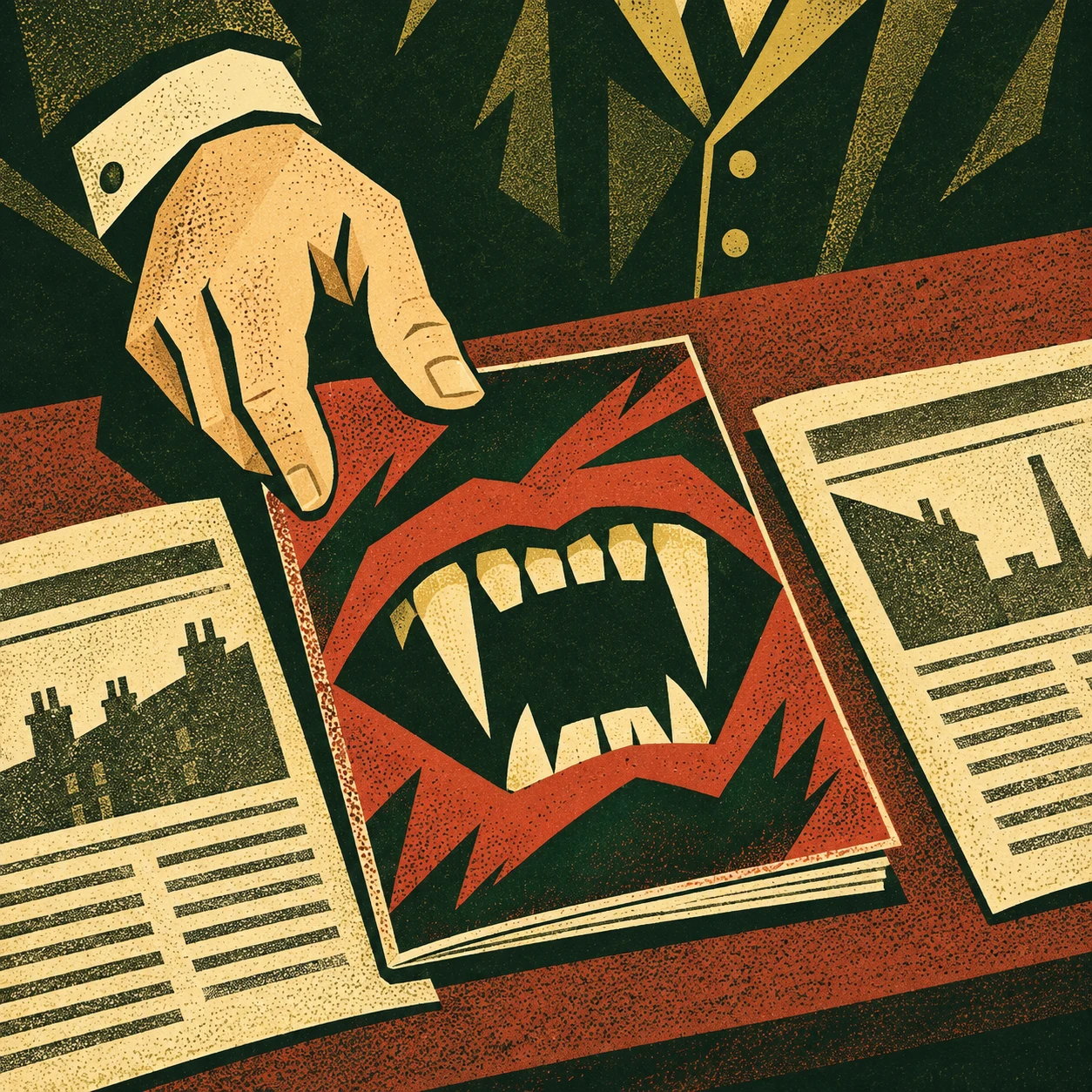
There was, in fact, an American comic with an unusually close title. The specialist bibliography English-Language Vampire Comics, 1935–2000 lists The Vampire with the Iron Teeth in Dark Mysteries number 15, dated December 1953. It is therefore mistaken to claim that no such comic existed before the Gorbals incident. Its date and subject make it a candidate worth examining, rather than something that can be dismissed because an earlier search failed to locate it.10
The timing establishes a possibility. An issue dated before the hunt could have circulated before it. That still leaves a series of separate questions: whether this issue reached Glasgow, who encountered it, whether a child passed on its details, and how those details became connected with the Southern Necropolis. A title answers none of those questions automatically. It is a much stronger clue than a general dislike of horror comics, but it remains a clue.
Comics collector Steve Banes, writing as Karswell on The Horrors of It All, made the stronger argument in 2010. His post pointed to the story, linked its 1953 issue and treated the rediscovery as an answer to the vampire's origins. That is a clear version of the comic-source theory from an actual proponent, rather than a weak argument invented for dismissal. Finding a near-matching published vampire is precisely the sort of evidence a serious search ought to welcome.11
The identified story is not simply the Gorbals incident drawn in panels. Fifties Horror’s discussion describes an aristocratic setting, a woman needing replacement teeth, and a plot involving iron dentistry and the teeth of a vampire. Its characters and narrative differ from a giant graveyard creature accused of eating two local boys. It supplies a distinctive feature that could be borrowed without supplying the whole Glasgow story.12
Differences of plot cannot rule out influence. Children retelling a story need not reproduce it accurately, and a rumour can attach fictional details to a familiar place. The specific match in the teeth therefore deserves more weight than the absence of a matching cemetery or pair of victims deserves against it. The difficulty is that a plausible transformation is still a proposed transformation until something connects the page with the people who passed the story on.
The collector's discovery changes what can responsibly be claimed. The argument cannot rest on the supposed non-existence of a relevant comic. Equally, the comic cannot serve as proof that its readers organised the hunt when those readers have not been identified. An old categorical dismissal and a new categorical solution can both go beyond the evidence. The remaining task is narrower and more concrete: find a contemporary reference, a local copy with useful provenance, or a securely documented reading connection.
That distinction also explains why the story remains worth investigating after the comic has been located. The interesting uncertainty is not whether something supernatural escaped from a drawing. It concerns how particular details moved between printed entertainment, ordinary talk and an accusation about a place. A surviving publication can show what was available to be borrowed. The route by which it might have been borrowed is a separate part of the history.
Horror on the screen
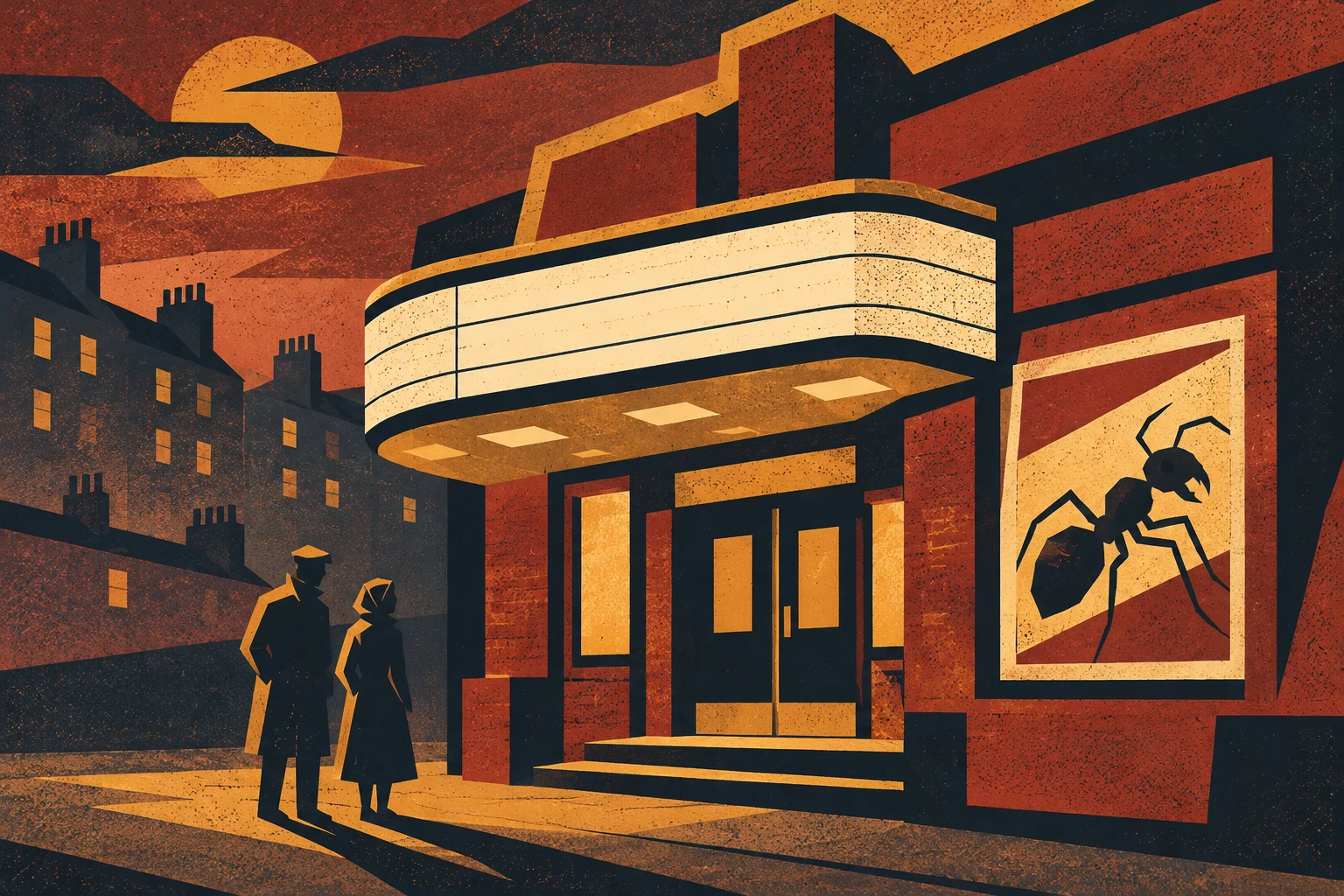
The first newspaper’s film suggestion was tentative.1 Later, Hobbs and Cornwell checked local cinema advertisements, including Them!, with its giant ants.2 A film could offer a vocabulary of monsters without supplying this vampire. Neither a listing nor a newspaper’s speculation identifies what the hunters had actually encountered.
Film classification complicates a simple account of children seeing whatever horror was showing nearby. The British Film Institute records that the X certificate replaced the H category in 1951 and restricted admission to those aged sixteen and over. A reference to an H film in a 1954 newspaper therefore used terminology that had already been superseded. The word could survive in ordinary speech even as the formal system changed; it cannot by itself identify a title or its actual audience.13
Nor does an age restriction establish what every child knew about a film. Advertising, an older person's description and conversation outside a cinema are different kinds of exposure from seeing the complete picture. Such possibilities explain why a source search should include publicity and talk. They also multiply the gaps. A title in a listing is evidence that a film was advertised, while knowledge of that title among specific hunters would require another source.
The remembered surroundings made those possibilities persuasive. Later local accounts describe the cemetery against the nearby ironworks and their red industrial light. Spooky Scotland connects that setting with recollections of the hunt, preserving an atmosphere which modern retellings often make central. The association is understandable: iron in the landscape and iron in a monster's mouth make a striking pairing. It remains an interpretation, rather than proof that an industrial sight produced the story.6
It is tempting to give the tale a single visible starting point. A poster, a furnace, an old verse or a comic page offers something that can be illustrated and named. A playground rumour is less convenient. It can acquire details as it moves, lose its first teller and arrive at the next child as a report of something already known. The absence of one recoverable beginning does not make the gathering mysterious in a supernatural sense.
There is also a difference between going on a hunt and having seen its quarry. The contemporary allegation supplied the vampire with victims and a location, but a child could join because others were going, because the story was frightening, or because it sounded exciting. The surviving records do not permit a precise division of the crowd into those motives. A photograph of children among graves, were one securely identified, would document their presence rather than settle what each believed.
The screen theory, like the comic and folklore theories, is strongest when kept at that scale. Entertainment and surrounding stories could contribute to a shared vocabulary of threats. The records consulted here do not identify one film as the trigger. By the time Parliament discussed the episode, however, the vampire had acquired a much firmer purpose in an adult story about what children needed protecting from.
A monster in Parliament
On 22 February 1955, John Rankin, the MP for Glasgow Tradeston, brought the cemetery hunt into the Commons debate on the Children and Young Persons (Harmful Publications) Bill. He described children arming themselves against a vampire with iron teeth and used the difficulty of controlling them to support the measure. In the same debate, Roy Jenkins cautioned against assuming that two things were causally connected merely because both occurred. The disagreement over evidence was already present at the time.15
The parliamentary account is not an independent confirmation of the vampire's alleged crimes. It shows how an episode could function as an argument for legislation. Rankin's description made the children's action a vivid example of influence. Jenkins's objection asked what established the link between reading and behaviour. The contrast is useful because it removes the need to invent a later sceptic correcting an age of unanimous certainty: contemporaries themselves disputed how much the available evidence justified.15
The government also had to define the material it intended to restrict. In the Lords on 21 April, Lord Mancroft explained a measure directed at publications consisting wholly or mainly of stories told in pictures. The concern covered depictions of crime, violence, cruelty and horrible incidents, presented in a way that made the publication corrupting as a whole. Its defenders wanted a narrow instrument aimed at horror comics, while acknowledging the difficulty of avoiding broader literary censorship.16
Nursery rhymes and established works of art entered that argument because horrifying content was not confined to the publications being condemned. Mancroft addressed examples including Three Blind Mice and insisted that the whole definition mattered. The debate was about form, context and likely effect as well as objectionable scenes. A legislature trying to distinguish a harmful comic from an acceptable frightening story faced a version of the ambiguity already present in Jenny's bedtime threat.16
The Act received Royal Assent on 6 May 1955. Its original printed text contains the pictorial-story definition and provides offences involving publication and sale, powers concerning seizure and disposal, and restrictions on importation. It did not name the Gorbals vampire or announce a finding about what had caused the hunt. A documented legislative outcome belongs to the history of the broader campaign; it does not retrospectively identify the source of a particular playground rumour.17
Calling this simply the vampire that changed the law makes an effective headline, but compresses the chronology. Parliament had debated American-style comics in 1952. The hunt later supplied supporters with an arresting example, alongside their other arguments. The resulting statute addressed a category of publications rather than the investigation of one incident. The sequence supports a connection between the hunt and the campaign, while keeping the stronger claim of a single decisive cause out of the narrative.1417
The irony was not lost on later observers. A monster supposedly threatening children had become evidence in an argument about protecting those children from frightening stories. The serious historical issue is how that example acquired its authority. The law establishes what Parliament enacted. The recorded speeches establish how members argued. Neither can supply the missing reader or first teller at the beginning of the graveyard story.
The teeth that stayed
The vampire survived in a different form. On 28 and 29 October 2016, the Citizens Theatre staged Johnny McKnight's The Gorbals Vampire following a community project. The theatre's own record describes local involvement, recorded memories and school activities, including comic-art workshops. A subject once invoked against children's reading had become a source of creative work involving children. That modern project is documented in its own right, without making its dramatic scenes evidence of events in 1954.18
McKnight explained his attraction to the story in an interview with Glasgowist. The idea of children deciding to confront the monster, rather than stay safely indoors, appealed to him as a playwright. His account concerns the making of a play, not a claim to have witnessed the hunt. It helps explain the story's modern appeal: the children can be cast as determined protagonists, with the frightening creature offering a stage on which their collective courage becomes visible.19
Official records show how broadly the project travelled. A 2018 Glasgow City Council report recorded an audience exceeding 1,500 across the production's three performances. Another council report described work with fifty-five St Francis Primary pupils, using the vampire incident to introduce aspects of local history and the Southern Necropolis. The story had become a way into the area's past, extending beyond whether anyone could identify the first child who repeated it.2021
A mural provided another public afterlife. South Glasgow Heritage and Environment Trust identifies the work by Ella Bryson and Art Pistol artists in an archway on St Luke's Place, near the theatre. The same account describes exhibitions, local artwork and school writing connected with the revival. These are new objects and interpretations produced around the legend. Their existence demonstrates the vampire's place in local culture, rather than the physical presence of the creature it depicts.22
The material record also includes collections rather than performances. The Hunterian's announcement for its 2016 Comic Invention exhibition included an Edwin Morgan scrapbook relating to horror comics and the Gorbals scandal. More recently, Glasgow Caledonian University interviewed a fashion student whose designs drew on both Jenny and the vampire. The forms keep changing: a newspaper incident, a political example, a scrapbook, a play, a mural and clothing inspired by remembered fear.2324
As of the research checked on 7 November 2026, no evidence consulted establishes a vampire killing two boys, or identifies one proven trigger for the hunt. The strongest record combines a real gathering with uncertain pathways of influence. The near-matching comic is genuine; the older Scottish bogey is genuine; the children's search is genuine. What remains missing is the connection that would turn one plausible ancestor into the single origin of the rumour.
The children left the cemetery without the monster. Their story proved harder to put away. Its teeth could be borrowed by campaigners, scholars and artists because the hunt offered something each could recognise: a warning about entertainment, a problem of folklore, or a group of children deciding to face a danger together. The sources preserve those uses separately. None requires the vampire itself to have been waiting among the graves.
Follow the evidence
Sources & further reading
- Police Had to Clear “Vampire” Hunters The Bulletin · 1954-09-24 · Accessed 2026-11-07
- Hunting the Monster with Iron Teeth Sandy Hobbs and David Cornwell · 1988 · Accessed 2026-11-07
- The Science and Politics of Play Sandy Hobbs and David Cornwell · 1985-09 · Accessed 2026-11-07
- Southern Necropolis: historical and educational assets Friends of Southern Necropolis / Colin Mackie · undated · Accessed 2026-11-07
- The Gorbals Vampire Rebecca Brown / Folklore Scotland · undated · Accessed 2026-11-07
- The Gorbals’ Vampire: The Iron-toothed Child Eater Spooky Scotland · undated · Accessed 2026-11-07
- How Comics Were Blamed for the Vampire Panic in 1950s Scotland Comic Book Legal Defense Fund · 2018-10 · Accessed 2026-11-07
- Jenny Wi’ the Airn Teeth Alexander Anderson · 1879 · Accessed 2026-11-07
- Daniel 7:7 King James Bible · 1611 translation · Accessed 2026-11-07
- English-Language Vampire Comics, 1935–2000 Robert Eighteen-Bisang, J. Gordon Melton and Massimo Introvigne / CESNUR · 2007 · Accessed 2026-11-07
- The Re-Post with Iron Teeth: The Gorbals Vampire Myth Karswell / Steve Banes · 2010-03-23 · Accessed 2026-11-07
- The Vampire With The Iron Teeth Fifties Horror · undated · Accessed 2026-11-07
- 10 Great X-certificate Films Anton Bitel / British Film Institute · 2019-05-23 · Accessed 2026-11-07
- American-Style Comics UK Parliament · 1952-08-01 · Accessed 2026-11-07
- Children and Young Persons (Harmful Publications) Bill: Second Reading UK Parliament · 1955-02-22 · Accessed 2026-11-07
- Children and Young Persons (Harmful Publications) Bill: Lords Second Reading UK Parliament · 1955-04-21 · Accessed 2026-11-07
- Children and Young Persons (Harmful Publications) Act 1955, as enacted UK Parliament / HMSO · 1955-05-06 · Accessed 2026-11-07
- The Gorbals Vampire Citizens Theatre · undated retrospective of 2016 production · Accessed 2026-11-07
- Glasgowist Meets The Gorbals Vampire Playwright Johnny McKnight Sophie McNaughton / Glasgowist · 2016-10-26 · Accessed 2026-11-07
- Citizens Theatre redevelopment report Glasgow City Council · 2018-02-22 · Accessed 2026-11-07
- Gorbals heritage learning project report Glasgow Community Planning Partnership · 2018-08-13 · Accessed 2026-11-07
- Gorbals Vampire Mural Saskia McCracken / South Glasgow Heritage and Environment Trust · 2020-10-26 · Accessed 2026-11-07
- Comic Invention Opening Soon University of Glasgow / The Hunterian · 2016-03-14 · Accessed 2026-11-07
- Student Sinks His Teeth into Vampire-inspired Fashion Project Glasgow Caledonian University · 2025-07-04 · Accessed 2026-11-07
- Vampire Hunters Out Again The Bulletin · 1954-09-25 · Accessed 2026-11-07
- Vampire Doesn’t Scare Any More The Bulletin · 1954-09-27 · Accessed 2026-11-07
- Vampire with the Iron Teeth / campaign coverage Daily Record · 1954-09-25 to 1954-09-29 · Accessed 2026-11-07
- Front-page report linking comics and the hunt Catholic Observer · 1954-10-01 · Accessed 2026-11-07